
Guide · Construction
Mud Tire Sidewalls: 3-Ply vs 2-Ply
Ply rating stopped meaning ply count decades ago. But the actual number of plies is still moulded into every tire by federal law — which makes this one of the few specifications you can verify yourself.
Ply rating is a historical unit
A Load Range E tire is described as having a 10-ply rating. It does not have ten plies. As Tire Rack puts it, the ply rating does not indicate the actual number of plies used — it is a rating indicating equivalent strength to earlier bias-ply tires. Modern radials reach the same strength with far fewer, much stronger plies.
What the load range genuinely tells you is the pressure at which the tire reaches its maximum load: 50 psi for C, 65 for D, 80 for E, 95 for F. And for LT tires wider than 295 mm, each of those drops a step — which is why a wide 37 in Load Range D tops out at 50 psi. We cover this in load range explained.
The actual ply count is on the tire, by law
This is the useful part, and almost nobody mentions it. Federal Motor Vehicle Safety Standard No. 139 requires every light-vehicle radial to have moulded into its sidewall the actual number of plies in the sidewall, and the actual number in the tread area if different, along with the generic name of each cord material. The markings must be at least 0.078″ high and 0.015″ deep.
So the authoritative source on ply count is not a marketing page or a retailer listing. It is the tire in front of you, and it will say something like “SIDEWALL: 3 PLIES POLYESTER”.
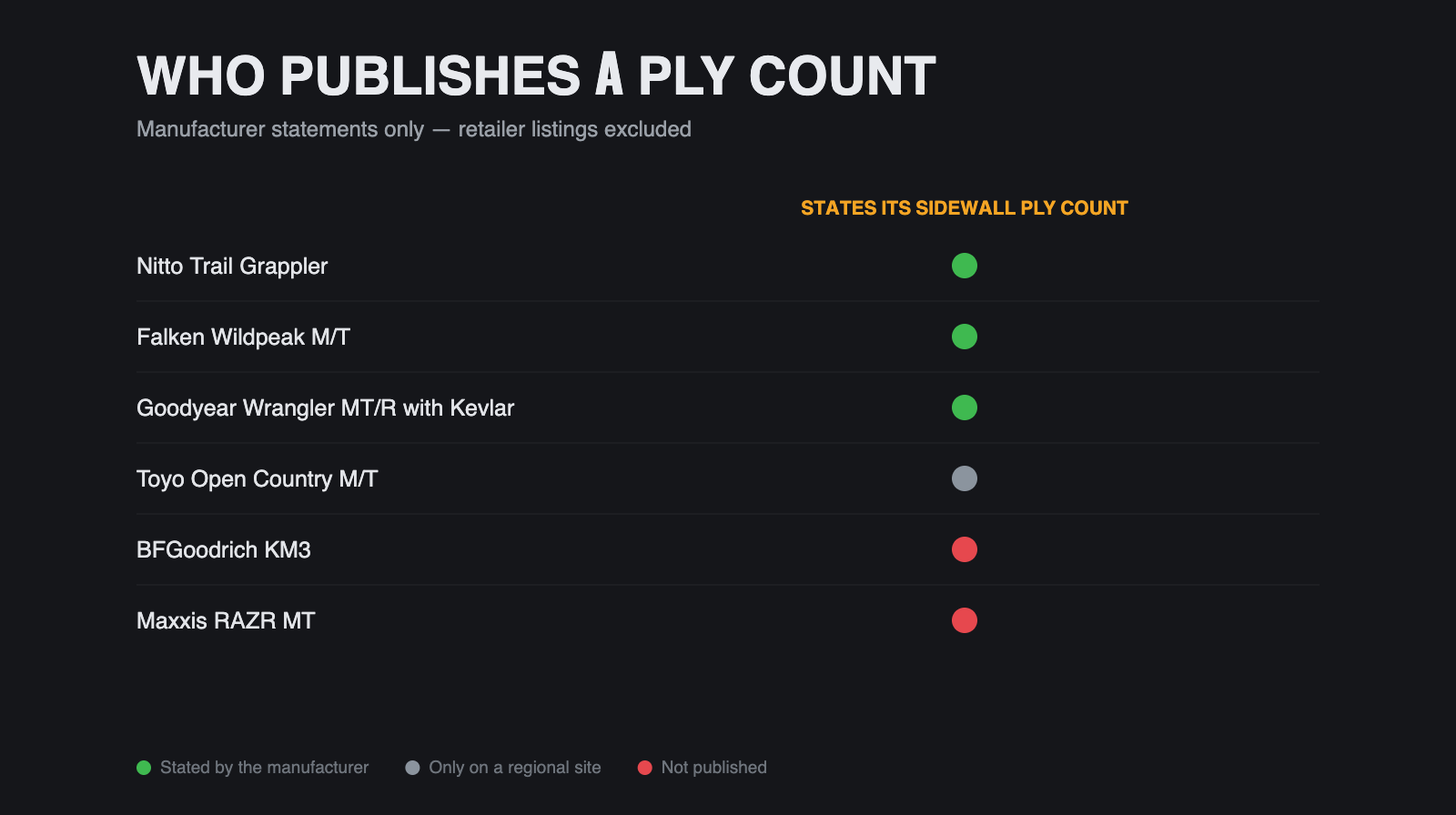
Three makers state a ply count outright. Toyo states it in Canada but not the US. Two publish nothing — despite retailers listing them as three-ply.
Who actually claims three plies
Nitto states it plainly for the Trail Grappler: a three-ply sidewall with high turn-up construction. Falken states three-ply DURASPEC with two high ply turn-ups for the Wildpeak M/T. Goodyear states a three-ply sidewall with opposing cord angles for the Wrangler MT/R with Kevlar.
Toyo is a curious case: its Canadian site describes the Open Country M/T as a high turn-up, three-ply polyester casing, while the US site says only “tough polyester construction” with no count. Same tire, two disclosure standards.
BFGoodrich publishes no ply count for the KM3. It markets CoreGard Max and a Linear Flex Zone, and claims a sidewall 27% tougher than the KM2 on internal puncture testing. Maxxis publishes no count for the RAZR MT either — it describes an “armor sidewall design” and “dual-cord body-ply technology”.
Where the phantom specifications come from
Search for the Maxxis RAZR MT and you will find dozens of dealers listing it as “RAZR MT MT-772 (3-ply sidewall)”. That string is part of the product name in a shared retail database, not a Maxxis specification. It propagates because every dealer draws from the same feed.
The same mechanism is why the KM3 is widely described as three-ply: Tire Rack describes a robust three-ply polyester casing, which is a credible independent description, but it is not BFGoodrich’s claim. Neither of those tires is necessarily two-ply. The point is that the number you are repeating did not come from the company that built it.
What a third ply buys, and what it costs
Puncture and cut resistance is the only benefit anyone quantifies, and only two manufacturers do: Goodyear’s 35% improvement over the previous MT/R, and BFGoodrich’s 27% over the KM2. Both are internal tests against their own predecessor, not against a competitor or an industry standard. Nitto and Falken frame the third ply simply as an extra layer of reinforcement.
Sidewall bite — the traction you get from the shoulder when aired down — is a separate matter of tread geometry, not ply count. Falken’s offset shoulder blocks, BFGoodrich’s Linear Flex Zone and Maxxis’s armor sidewall design are all about that, and a ply count tells you nothing about it.
As for the costs: heavier, harsher and dearer is the universal owner experience, and we could not find a single manufacturer publishing a controlled comparison of the same tread in two-ply and three-ply form. Treat the penalty as real but unquantified.
One thing a ply count does not tell you
Load capacity. Nitto’s Trail Grappler is three-ply in both LT285/70R17 and LT315/70R17, and both carry load index 121. But one is Load Range E reaching 3,195 lb at 80 psi and the other is Load Range D reaching the same 3,195 lb at 50 psi. Same construction, same capacity, different pressure to get there.
Ply count and load range are independent variables. Buy on the one that matches what you are asking the tire to do.
Watch
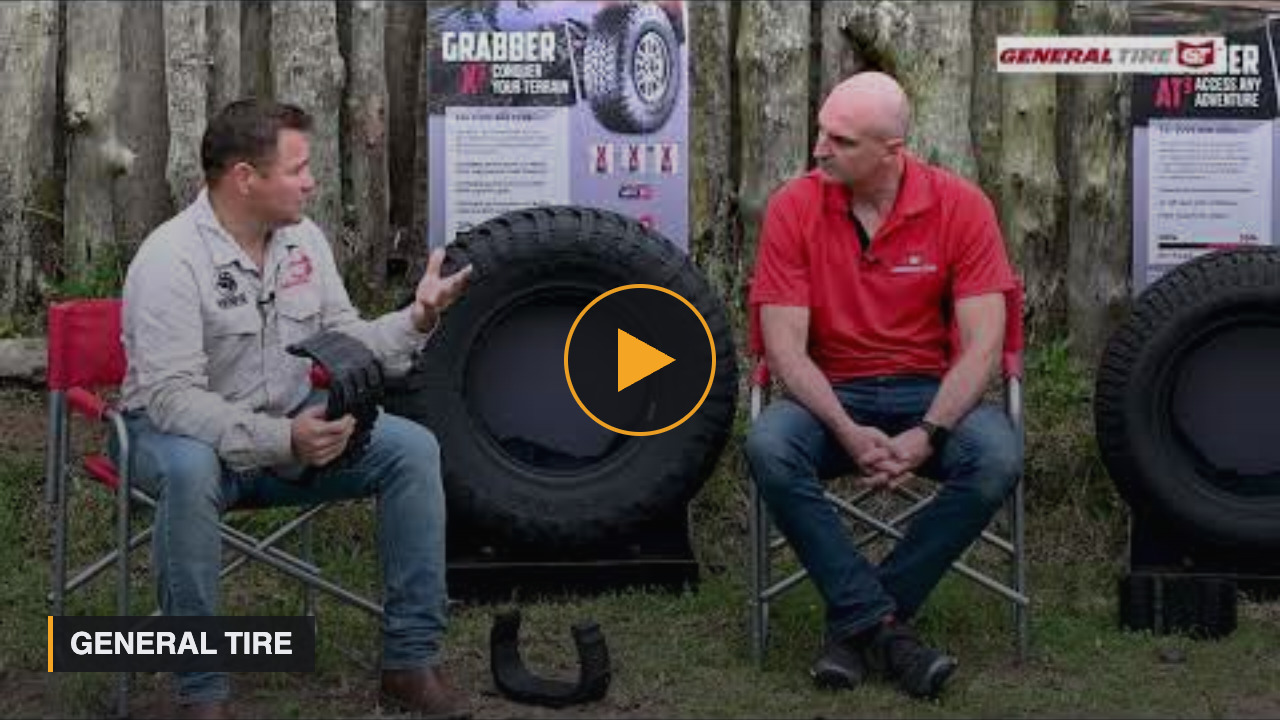
General Tire explaining ply construction directly — a manufacturer on the exact distinction this page is built around.
Watch on YouTube →Sources
Tire Rack, What are load ranges / ply ratings? (tirerack.com) · Tire Rack, What is maximum load for a tire? (tirerack.com) · eCFR, 49 CFR 571.139 Standard No. 139 (ecfr.gov) · Nitto Tire, Trail Grappler mud-terrain light truck tire (nittotire.com) · Falken Tires, Wildpeak M/T (falkentire.com) · Goodyear, New Goodyear Wrangler MT/R with Kevlar (news.goodyear.com) · Toyo Tires Canada, Open Country M/T (toyotires.ca) · Toyo Tires, Open Country M/T (toyotires.com) · BFGoodrich, Mud-Terrain T/A KM3 (bfgoodrichtires.com) · Maxxis US, RAZR MT (maxxis.com) · Tire Rack, BFGoodrich Mud-Terrain T/A KM3 (tirerack.com). Retrieved 10 September 2026.
We may earn a commission if you buy through links on this site. Commission plays no part in which tires are listed or how they are ordered.