

Guide · Maintenance
When to replace mud tires
The legal minimum and the safe minimum are not the same number. In Tire Rack’s wet braking test from 60mph, a sedan on 2/32in tread needed 195 more feet to stop than on new tires; a light truck needed 71 more.
By Cole Harlan · Last reviewed 29 September 2026
The numbers that matter
Tread depth is measured in thirty-seconds of an inch. New tires typically start around 10/32in and up; mud-terrains often start deeper. The thresholds below are where the decisions sit.
Depth
What it means
Verdict
10/32in
Roughly new tread on a typical tire
Full wet performance
4/32in
The depth Tire Rack recommends replacing at if you regularly drive in the wet
Start shopping
2/32in
Legal minimum in most US states; wear bars sit flush with the tread here
Replace now
1/32in
Legal minimum in California (Vehicle Code 27465)
Well past safe
California sets 1/32in in statute (Vehicle Code 27465). We could not find a tread-depth figure in the tire statutes of Idaho (§49-948), Arkansas (§27-37-401), Mississippi (§63-7-67), Montana (§61-9-406) or South Carolina (§56-5-5040): they require tires to be safe without naming a depth. Massachusetts has no statutory figure, but its inspection regulation (540 CMR 4.04) fails a tire below 2/32in. North Dakota’s tire statute (NDCC §39-21-40) names no depth either, though it does require any tire larger than the factory size to carry a DOT tire identification number (§39-21-45.1). West Virginia has no statutory figure, but its State Police inspection manual (§9.21, September 2024 edition) fails a tire with less than 2mm (about 2.5/32in) left in two adjacent grooves, and fails any tire marked “Off-Highway Use Only”, so check the sidewall of an aggressive mud tire before inspection. Everywhere else, 2/32in is the usual line; check your own state’s code or inspection rules.
Correction (29 September 2026): this section previously said 2/32in was the legal minimum “in 42 US states”, that 1/32in applied “in California and Idaho only”, and that seven states had no statutory requirement. Those groups added up to 51 states, and Idaho’s tire statute sets no depth figure. We have replaced the count with what we checked against each state’s own code, and re-sourced the stopping distances to Tire Rack’s published test (they previously read about 195 and 380 feet from 70mph, from a secondary source). This note keeps the original wording on record, per our corrections policy. Update (29 September 2026): North Dakota and West Virginia are now confirmed from the North Dakota Century Code and the West Virginia State Police inspection manual, replacing a third-party list; West Virginia’s 2mm inspection line was added.
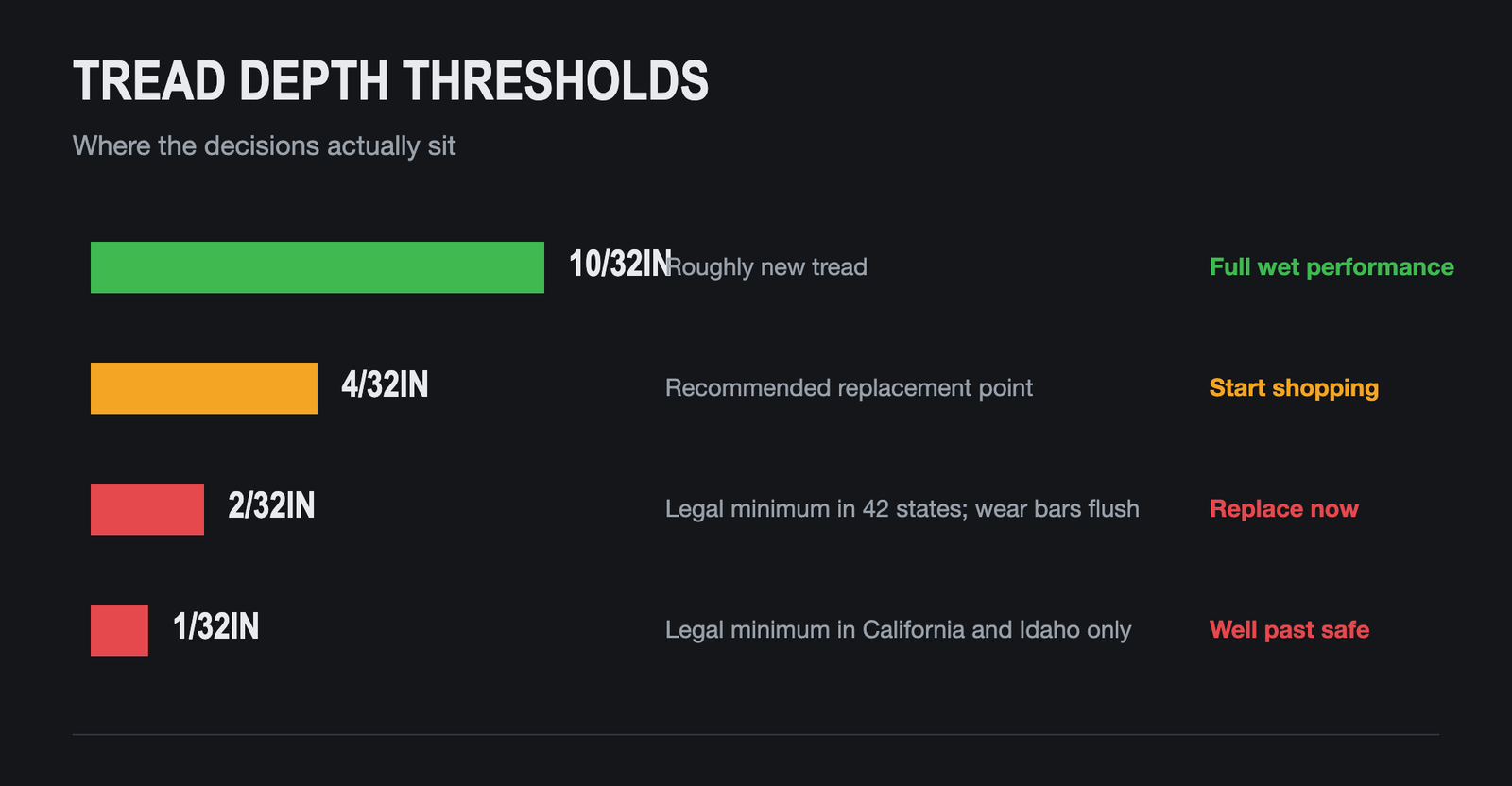
Legal minimum and safe minimum are different numbers. Wear bars sit at 2/32in, flush with the tread.
Why 4/32in, not 2/32in
Wet stopping distance is the reason. In Tire Rack’s published test from 60mph on wet asphalt, a sedan stopped in 205 feet on new tires, 270 feet at 4/32in and 400 feet at 2/32in: 95% further at the legal limit. A light truck, the closer match for most mud-terrain owners, stopped in 216, 261 and 287 feet: 33% further at 2/32in.
Put plainly: at the legal limit the sedan in that test needed almost twice the distance, and even the light truck needed an extra 71 feet. The legal minimum describes when you can be cited, not when the tire stopped being safe.
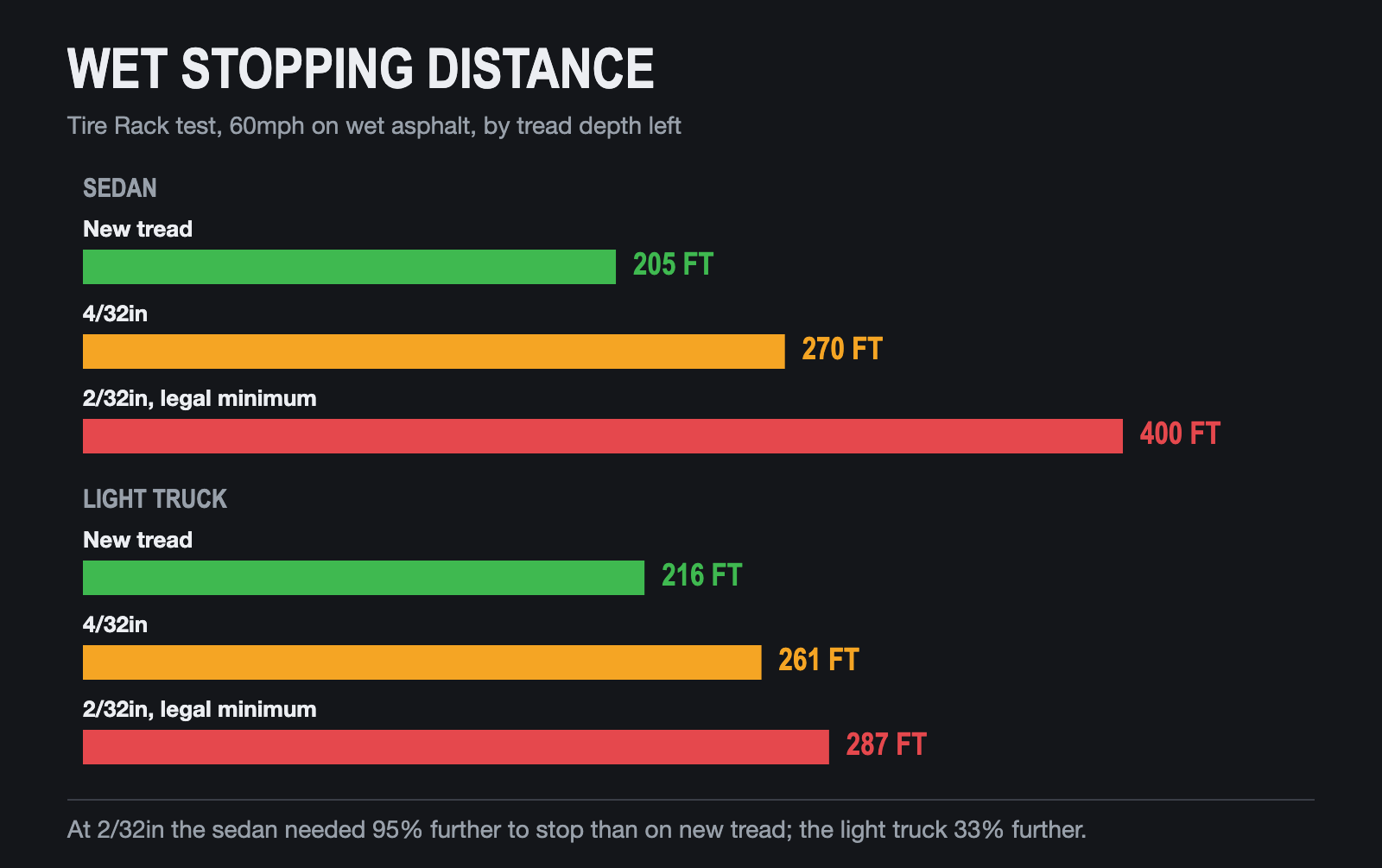
In Tire Rack’s 60mph wet test, a sedan’s stop grew from 205 feet on new tread to 400 feet at 2/32in; a light truck’s from 216 to 287 feet.

Finding your wear bars
Every DOT-legal tire has moulded wear indicator bars sitting in the tread grooves at exactly 2/32in. When those bars sit flush with the surrounding tread blocks, the tire is at the legal limit and should already have been replaced.
On a mud-terrain the bars can be harder to spot than on a highway tire, because the tread blocks are larger and the voids deeper. Look in the circumferential grooves rather than between the outer lugs.
What’s different about mud-terrains
Mud-terrains start with deeper tread than highway tires, so they have further to wear, but the same 2/32in and 4/32in thresholds still apply, because those are about water evacuation, not about how much rubber you started with.
Two failure modes matter more on M/Ts than on highway tires: uneven or cupped wear from missed rotations, which large blocks are prone to, and chunking, where pieces tear from a block after off-road use. A tire can have legal depth and still need replacing if blocks are chunked or the sidewall is damaged. Depth is a minimum test, not the only test.
Age, not just depth
Rubber degrades whether or not you drive on it. A tire with plenty of tread that has been on the vehicle for many years, or stored in sunlight, can develop sidewall cracking that no depth gauge will reveal. Check the DOT date code on the sidewall: the last four digits give the week and year of manufacture.
This matters disproportionately for mud-terrains, because they are frequently fitted to vehicles that cover low annual mileage.
Related on Mud Tires
corrections log · mud tire warranties compared · running mud tires as a daily driver · what mud tires cost in fuel economy · how loud mud tires actually are · why mud tires shake · budget mud tires · the mud tire price tracker · how mud tires behave in snow · Tire model pages · All mud tire comparisons
Sources
Tire Rack, “How Much Does Tire Tread Depth Affect Wet Braking?” (tirerack.com) · California Vehicle Code §27465 (leginfo.legislature.ca.gov) · Idaho Code §49-948 (legislature.idaho.gov) · Arkansas Code §27-37-401 · Mississippi Code §63-7-67 · Montana Code Annotated §61-9-406 (mca.legmt.gov) · South Carolina Code §56-5-5040 (scstatehouse.gov) · Massachusetts 540 CMR 4.04 (law.cornell.edu) · TireGrades, “Minimum Tire Tread Depth: Legal Limits by State” (tiregrades.com). · North Dakota Century Code §39-21-40 and §39-21-45.1 (ndlegis.gov) · West Virginia State Police, Official Motor Vehicle Inspection Manual §9.21, September 2024 (wvsp.gov). Retrieved 29 September 2026.
Further reading: NHTSA’s tire safety and aging guidance · how much tread depth is actually enough
Cite this page: Mud Tires, “When to Replace Mud Tires”, mudtires.org/when-to-replace-mud-tires/ (updated ).
Source links on this site are checked every month; last check . How sources are checked.