
Guide · Choosing
Mud tires vs all-terrain: which do you actually need?
Most people who buy mud-terrains would be better served by an all-terrain, and most people who say that have never been properly stuck. Here is the honest split.
By Cole Harlan · Last reviewed 10 September 2026
The engineering difference in one paragraph
A mud-terrain uses large tread blocks separated by wide voids. The voids exist to eject mud: the block bites, the void clears the material, the next block bites clean. An all-terrain uses smaller blocks, tighter spacing and far more siping, which trades mud-clearing for contact area, quieter running and better wet and snow behaviour on pavement.
Everything else follows from that one trade-off. Void ratio is the whole argument.
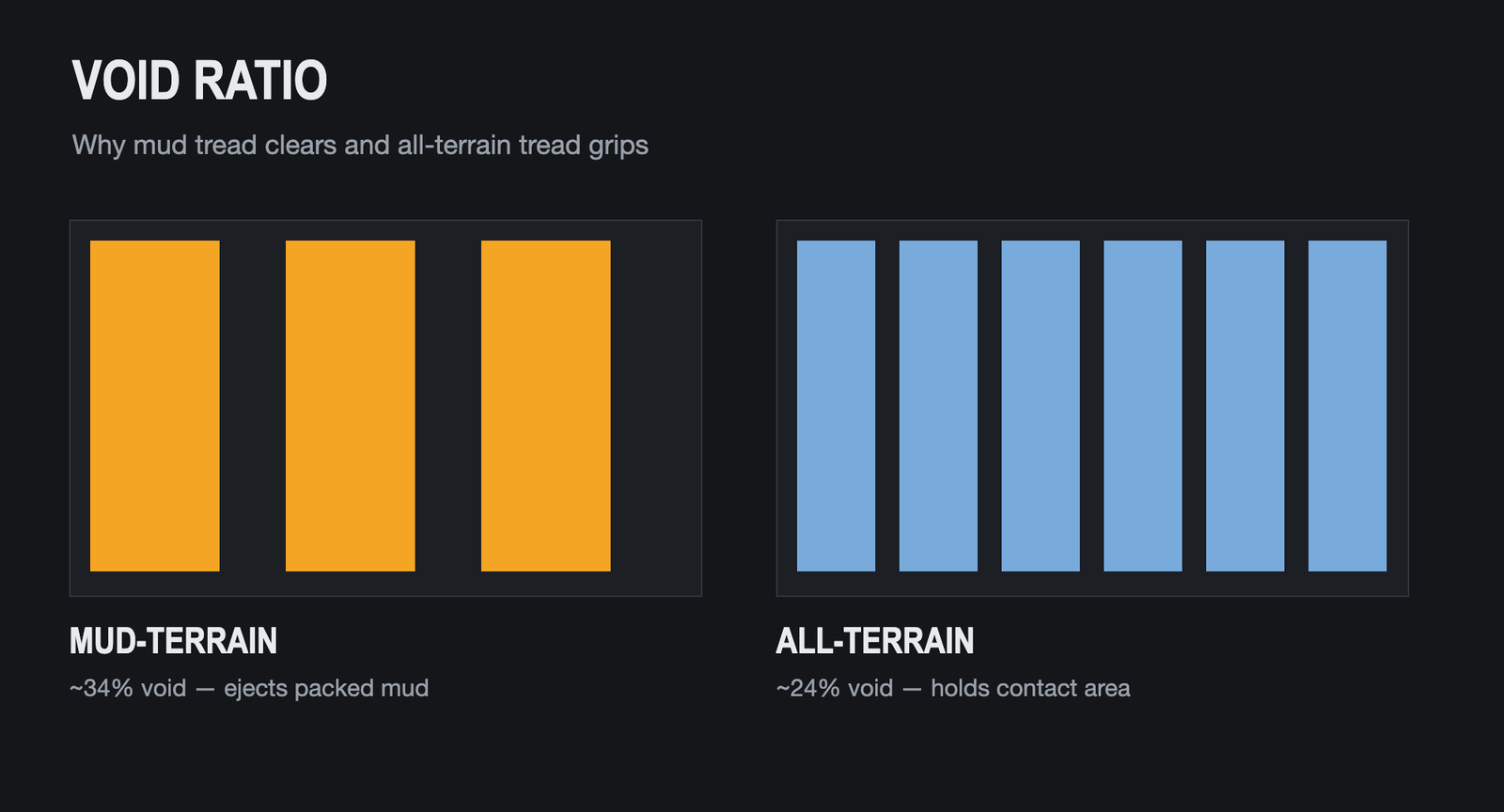
Void ratio is the whole argument: wide voids eject mud, tighter spacing and siping hold contact area on pavement.
What each does better
Mud-terrain
All-terrain
Deep mud and clay
Designed for it
Clogs and loses bite
Rock and sharp terrain
Tougher sidewall construction is common
Varies; usually lighter construction
Pavement noise
The most common owner complaint
Materially quieter
Wet pavement
Fewer sipes, less biting edge
More siping, generally better
Snow certification
Rare; none in our comparison set carries 3PMSF
Increasingly common
Tread life
Shorter, and uneven wear is easier to provoke
Generally longer
Fuel economy
Heavier and higher rolling resistance
Less penalty
Category generalisations. Individual models vary considerably, and construction differs across sizes within a single model line.
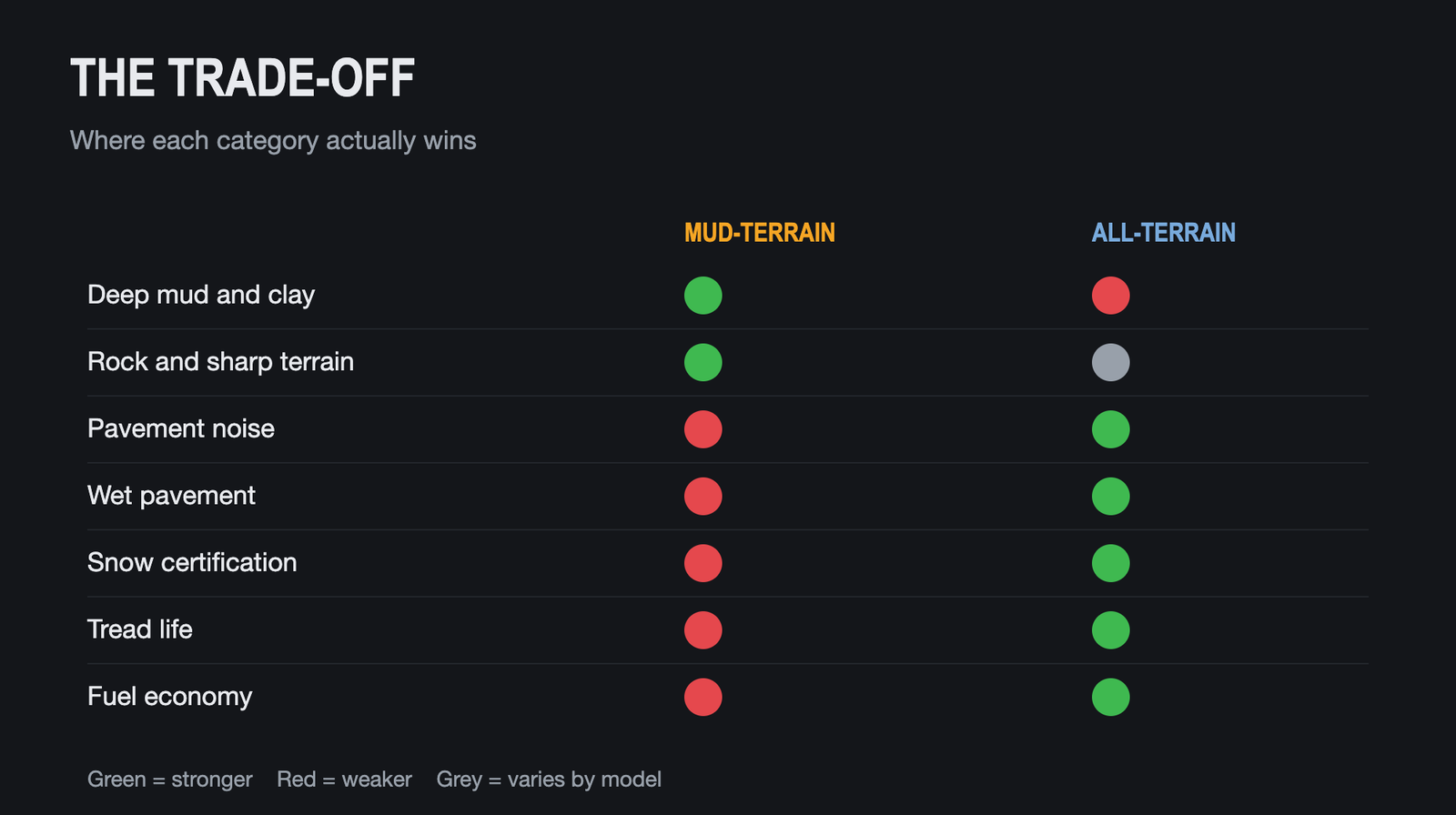
Category generalisations: individual models vary, and construction differs across sizes within one model line.
The honest test
Ask how often you are in mud deep enough that an all-terrain would actually fail. Not trail driving. Not a wet field. Mud deep enough to pack a tread and stop the vehicle.
If the honest answer is a handful of times a year, an all-terrain with a decent sidewall will do the job, and you will get quieter running, better wet behaviour, longer tread life and probably a 3PMSF rating. If the honest answer is regularly, in that you work on unsealed ground, you tow off pavement or you wheel seriously, the mud-terrain earns its compromises.
The compromise people underestimate
Noise is the complaint that dominates owner feedback, and it gets worse rather than better. Manufacturer noise claims are made on new tires; as large blocks wear, particularly unevenly, the sound signature grows. A tire that was acceptable at delivery can become tiring at half tread.
Winter capability is the compromise people underestimate second. Aggressive tread reads as capable, but severe-snow capability is a certification with a measured threshold, and mud-terrains almost never carry it. Our snow guide covers exactly what that certification does and does not cover.
The hybrid middle
A growing category sits between the two: tires marketed as rugged-terrain or hybrid, with mud-terrain block sizing on the shoulders and all-terrain siping through the centre. On paper they promise most of the mud capability with a fraction of the noise.
We have not yet sourced comparable published data for these, so we are not ranking them. They belong on your shortlist; we just cannot yet tell you where they land against the tires we have documented.
Watch
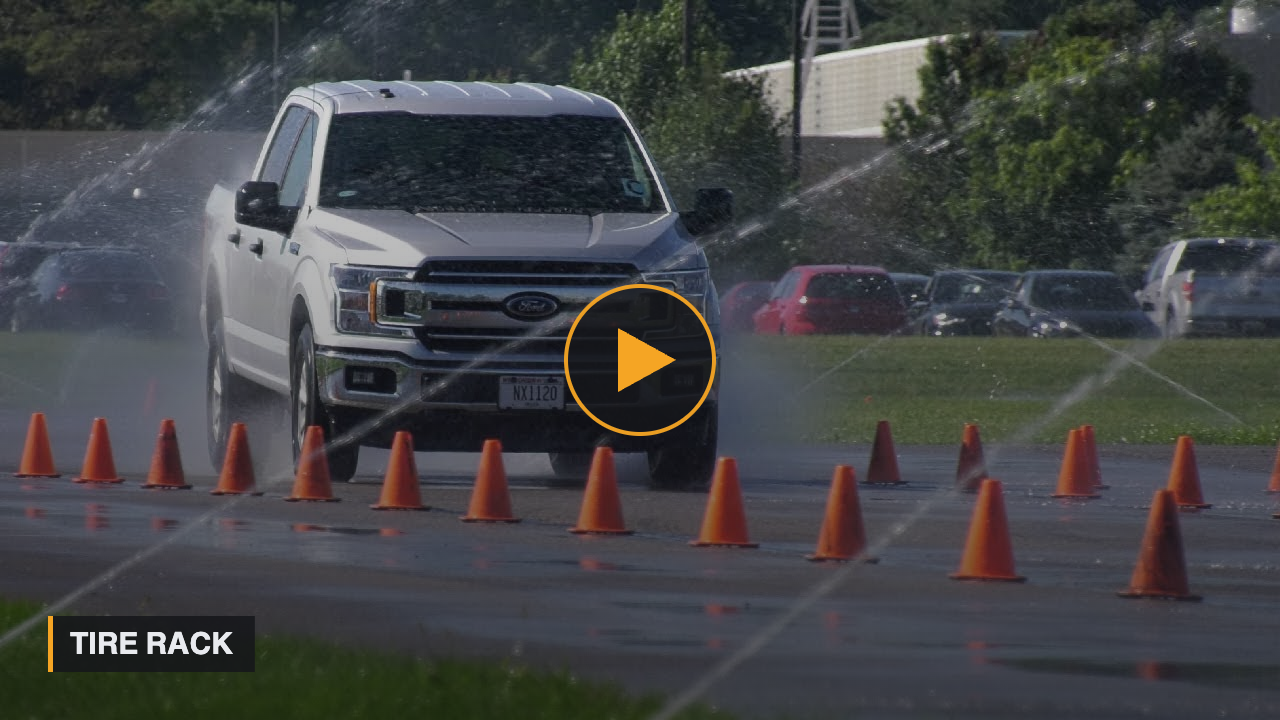
Tire Rack testing on-/off-road all-terrain tires for everyday use, useful context for the pavement side of this trade-off.
Watch on YouTube →Related on Mud Tires
rugged-terrain vs mud-terrain · running mud tires as a daily driver · how mud tires behave in snow · how loud mud tires actually are · what mud tires cost in fuel economy · load range explained · budget mud tires · moving up to 35-inch mud tires · how we test and compare · KM3 vs KO2 · Open Country M/T vs R/T · KM3 vs STT Pro
Sources
Nitto Tire, Trail Grappler M/T product specifications (nittotire.com) · SimpleTire comparison data (simpletire.com) · Tire Rack, three-peak mountain snowflake explainer (tirerack.com). Retrieved 9 September 2026.
Further reading: J.D. Power’s all-terrain versus mud-terrain guide · a plain-English breakdown of tread void
Cite this page: Mud Tires, “Mud Tires vs All-Terrain Tires”, mudtires.org/mud-tires-vs-all-terrain/ (updated ).
Source links on this site are checked every month; last check . How sources are checked.