
Guide · Winter
Are mud tires any good in snow?
Aggressive tread looks like it ought to bite into snow, and the marketing rarely discourages that assumption. The certification data says something far more specific, and far more limited, than most buyers realise.
By Cole Harlan · Last reviewed 10 September 2026
The short answer
A mud-terrain tread is engineered to clear mud, not to compact snow. Those are close to opposite jobs. Mud performance comes from large blocks and wide voids that fling material out; snow traction comes from fine siping and a tread that packs snow against snow, because snow grips itself far better than rubber grips it.
That is why almost no mud-terrain carries the three-peak mountain snowflake symbol, and why none of the tires in our comparisons does.
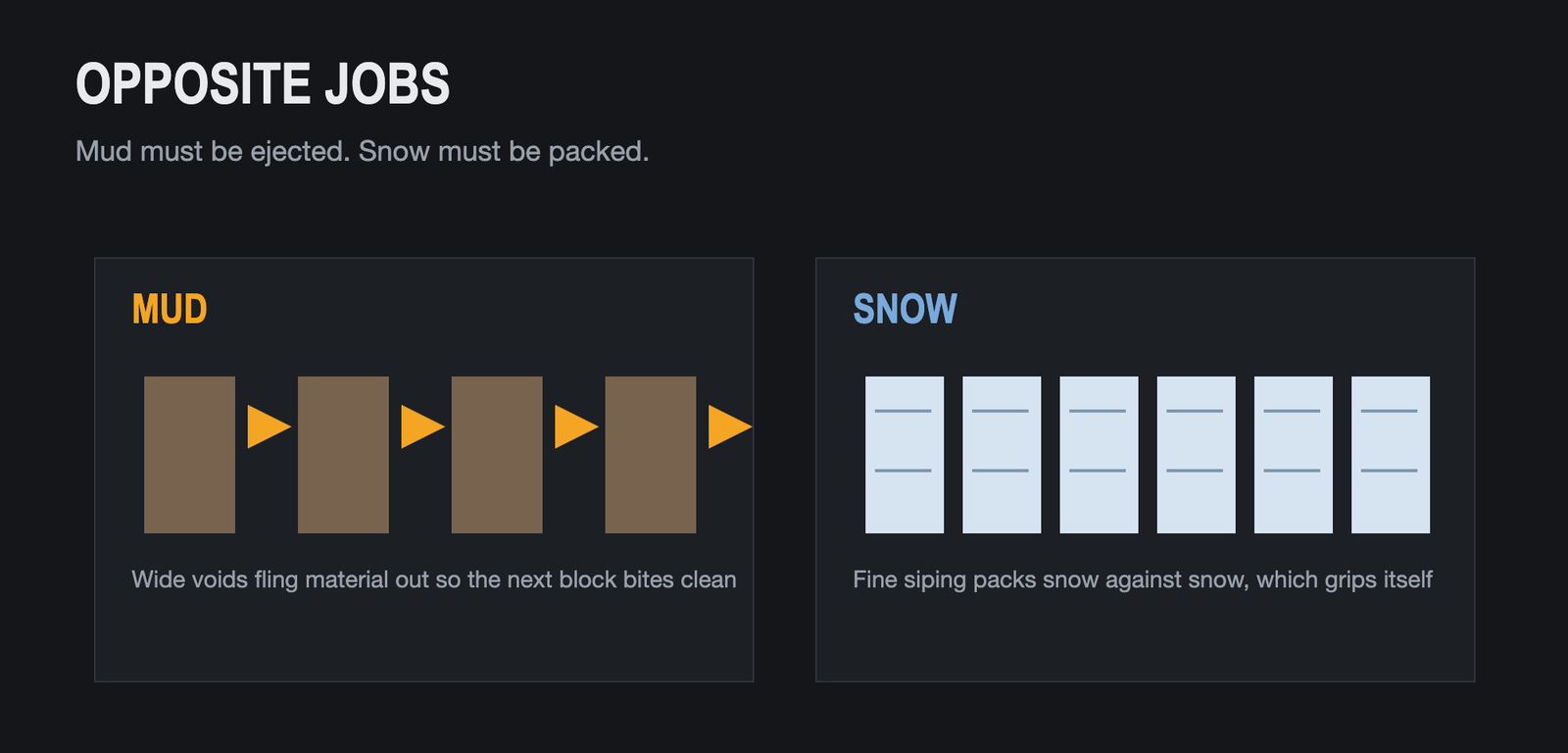
Mud performance comes from wide voids that eject material; snow traction comes from siping that packs snow against snow.
What 3PMSF actually certifies
The three-peak mountain snowflake was established in 1999 by the U.S. Tire Manufacturers Association and the Rubber Association of Canada. To earn it, a tire must pass an ASTM traction test on packed snow and reach a traction index of at least 110 against a 14-inch reference tire, or 112 against a 16-inch reference, where the reference tire itself scores 100.
Here is the part almost nobody mentions: that test measures acceleration traction on medium-packed snow only. Braking on snow is not assessed. Cornering is not assessed. Ice is not assessed at all.
Marking
What it certifies
What it does not cover
3PMSF
Acceleration traction on medium-packed snow, index of 110 or 112 against a reference tire
Braking, cornering, ice, deep snow, slush
M+S
Nothing measured; awarded on tread geometry alone
Any performance guarantee whatsoever
Neither marking
No snow claim is being made
—
A 3PMSF tire is therefore certified to get moving in snow better than one without it. It is not certified to stop or turn any better.
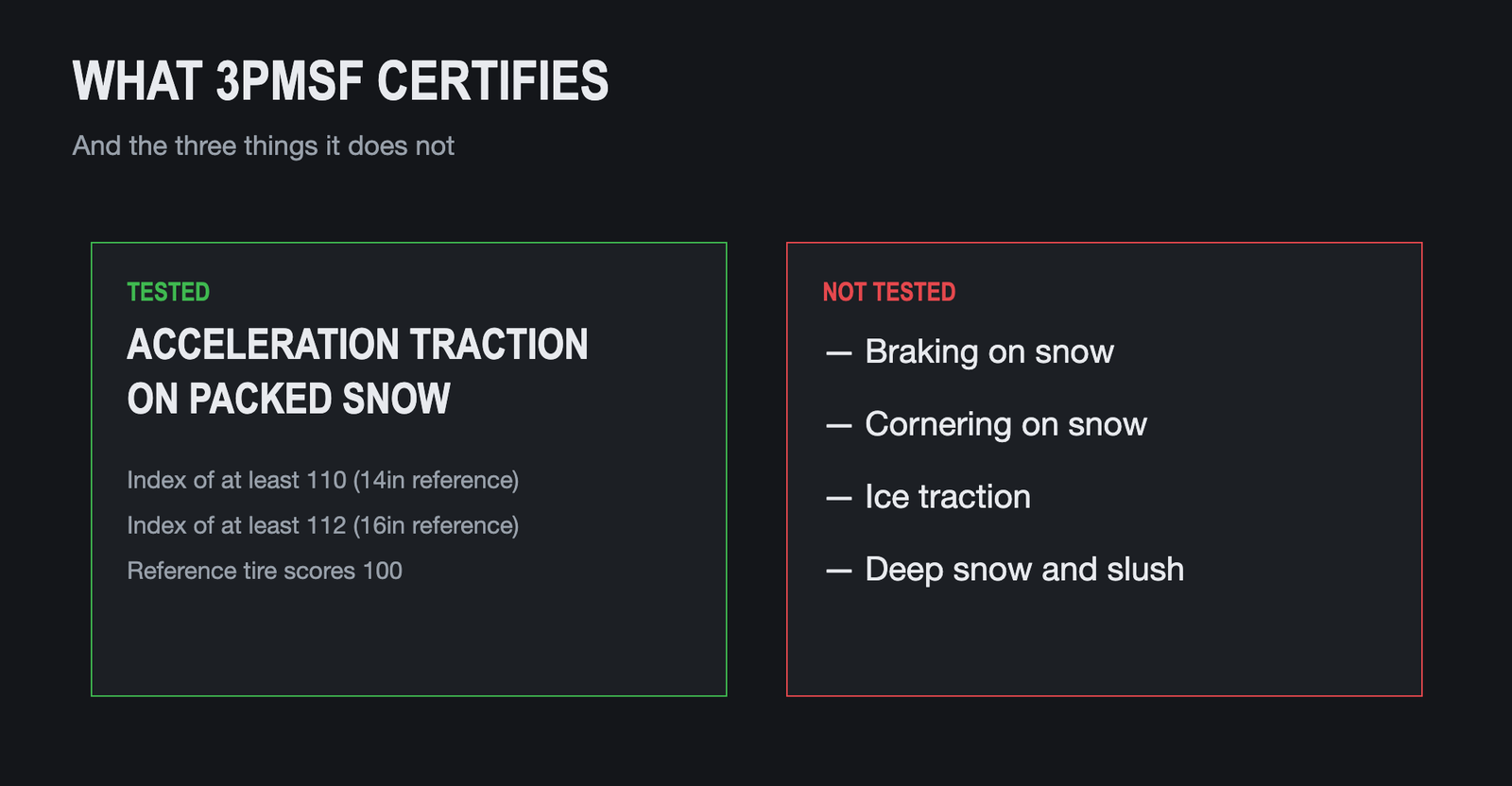
The 3PMSF test measures acceleration traction on packed snow only; braking, cornering and ice are not assessed.
M+S is not a winter rating
Most mud-terrains carry an M+S stamp, and a great many buyers read that as winter capability. It is not. M+S is awarded on tread pattern geometry, essentially the ratio of void to contact area, and makes no guarantee of any performance capability. A tire can carry M+S and have been tested on snow exactly never.
If you take one thing from this page: M+S describes a shape. 3PMSF describes a measured result.
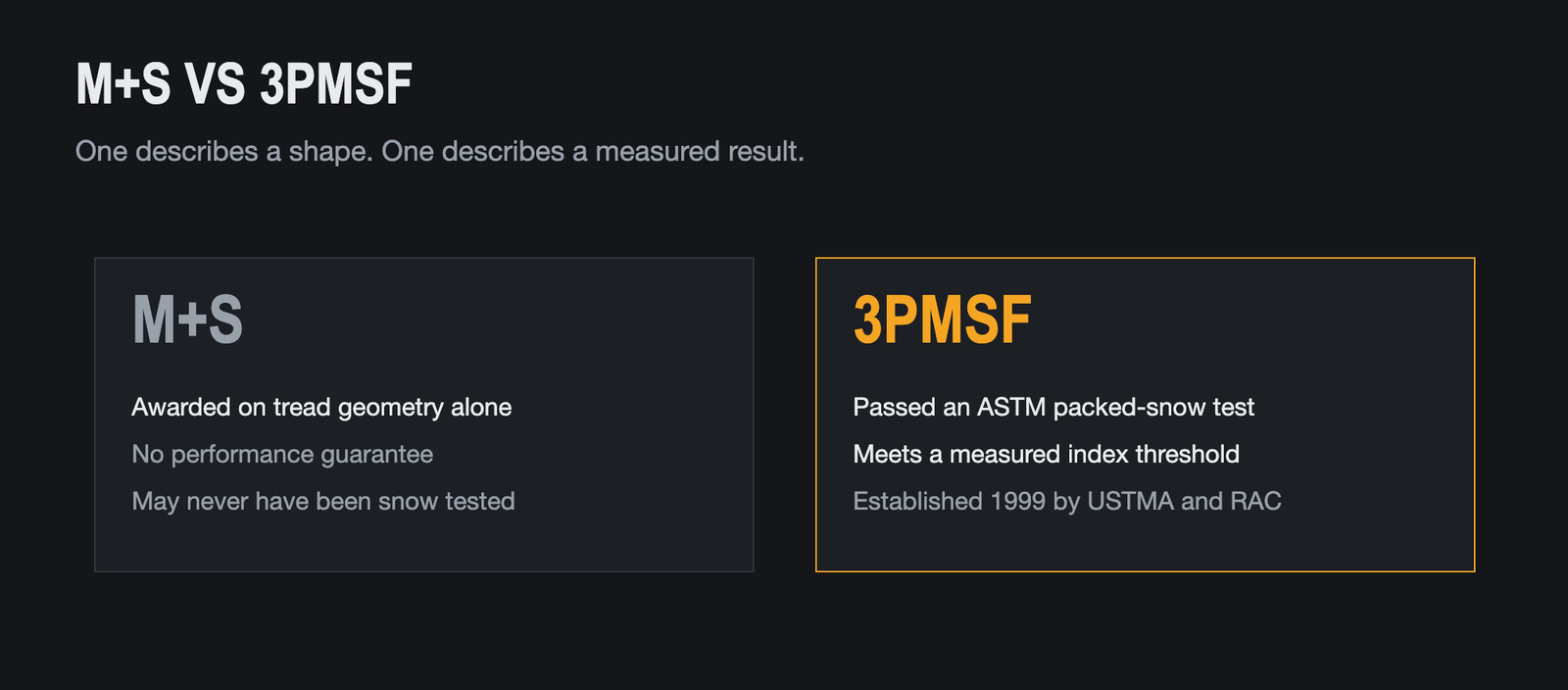
M+S is awarded on tread geometry alone. 3PMSF requires passing a measured snow traction test.

Where that leaves the tires we’ve compared
None of the mud-terrains in our current comparison set carries 3PMSF certification. Where a manufacturer publishes nothing about snow, we record that as a gap rather than inferring capability from how the tread looks.
Tire
3PMSF
What the manufacturer publishes
Not stated
Deep centre sipes claimed to reduce hydroplaning; no snow certification mentioned
“Not stated” means the manufacturer publishes no claim either way, not that the tire failed a test.
What to do if you actually see winter
If you live somewhere with sustained snow and ice, the honest answer is that a mud-terrain is the wrong tool, and no amount of tread aggression changes the certification. Two things work: a dedicated winter tire on a second set of wheels, or an all-terrain carrying 3PMSF, which a growing number now do.
Some jurisdictions and insurers treat 3PMSF as the standard for winter compliance, so the marking can matter legally as well as practically. Check your local requirement rather than assuming aggressive tread qualifies: here is what five states’ traction and chain laws accept.
The gap in the evidence
We could not find independent, published braking or cornering data on snow for any of these tires. That is a genuine hole in the public record, and it is why this page explains what the certifications mean rather than ranking these tires against each other for winter use. We would rather tell you we don’t know than invent a ranking.
Related on Mud Tires
mud-terrain vs all-terrain · rugged-terrain vs mud-terrain · running mud tires as a daily driver · airing down for mud · when to replace a mud tire · KM3 vs Trail Grappler · Falken Wildpeak M/T vs KM3 · mud tires for a Jeep Wrangler JL · KM3 vs STT Pro · Wildpeak M/T vs Open Country M/T
Sources
Tire Rack, “What is the Three-Peak Mountain Snowflake Symbol?” (tirerack.com) · Nitto Tire, Trail Grappler M/T product specifications (nittotire.com) · SimpleTire, Falken Wildpeak M/T01 vs Toyo Open Country M/T (simpletire.com) · BFGoodrich, Mud-Terrain T/A KM3 product page (bfgoodrichtires.com). Retrieved 9 September 2026.
Further reading: the three-peak mountain snowflake standard · USTMA’s official M+S snow tire definition
Cite this page: Mud Tires, “Are Mud Tires Any Good in Snow?”, mudtires.org/mud-tires-in-snow/ (updated ).
Source links on this site are checked every month; last check . How sources are checked.