
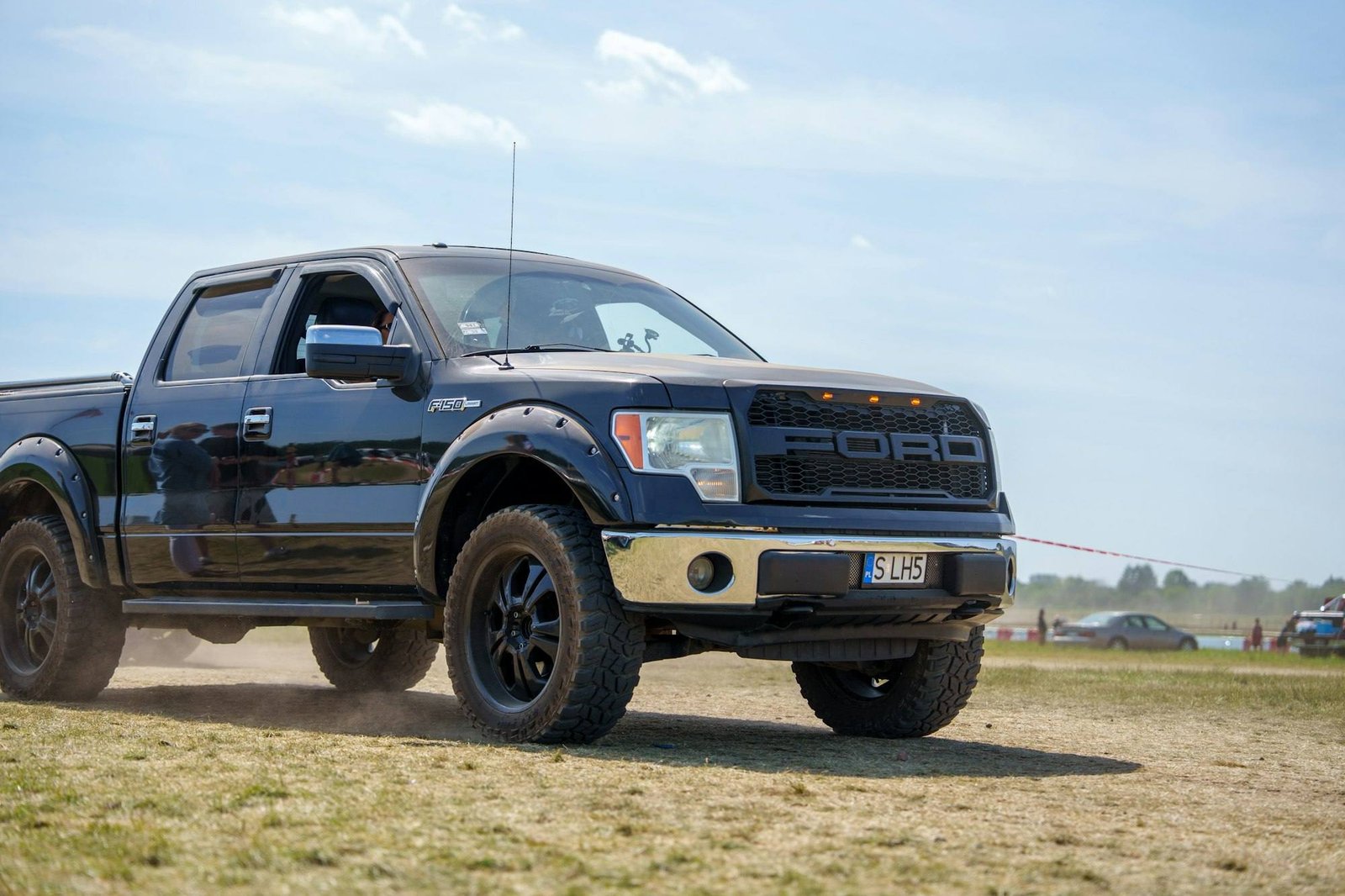
Fitment · Ford F-150
Mud Tires for a Ford F-150
On an F-150 the most consequential decision is not which mud-terrain you buy. It is what diameter wheel you put it on, and Ford’s own highest-payload truck runs a Load Range C tire.

By Cole Harlan · Last reviewed 10 September 2026
Wheel diameter matters more than tire model
Most F-150s are not on 17-inch wheels. Lariat, King Ranch and Platinum trucks run 20s or 22s, and that single fact changes the tire conversation more than any difference between a KM3 and a Trail Grappler.
Sidewall is what deflects when you air down and what absorbs the impact when you do not. A 35×12.50R20 has 7.50 inches of it. The same tire on an 18 has 8.50, and on a 17 it has 9.00, twenty per cent more. The Raptor’s factory 35 has 8.68 inches, so the 20-inch 35 most owners buy is meaningfully short of what Ford specified for its own desert truck.
The 20-inch fitment is also the most expensive. A BFGoodrich KM3 in LT285/70R17 was $339.99 on 10 September 2026; the same tire in 35×12.50R20 was $549.99, $840 more across a set of four, for less sidewall and a narrower selection. Dropping wheel diameter is the cheapest improvement available on this platform.

A 35 on a 20-inch wheel gives you 7.50 inches of sidewall. The same 35 on a 17 gives you 9.00.
Ford’s heaviest F-150 runs Load Range C
The Heavy-Duty Payload Package raises GVWR to 7,850 lb on XL and XLT, and Ford specifies it with LT275/65R18C tires. Load Range C. The FX4 package’s optional LT tires are also C.
Run the axle numbers and you see why. A SuperCrew’s rear GAWR of 4,150 lb is 2,075 lb per tire; the front’s 3,750 lb is 1,875 lb per tire. The lowest-capacity Load Range E mud-terrain in this comparison carries 2,910 lb. The margin is over 40% on the rear axle and over 55% on the front.
So on a half-ton, load index is essentially never the binding constraint. Buying Load Range E buys carcass durability against sidewall puncture and heat under sustained tow. It does not buy load capacity you need, and it costs ride quality and unsprung mass. On a 20-inch wheel with six and a half inches of sidewall, on a comfort trim, a stiff E carcass is the harshest combination available on this truck.
The speed rating you give up
Factory F-150 tires are T-rated, or 118 mph. Every mud-terrain here is Q, which is 99. Fitting one drops the truck 19 mph of speed rating.
Toyo is worse in two core F-150 sizes: its Open Country M/T in LT275/65R18 and in LT285/70R17 Load Range E are P-rated, which is 93 mph. That is a 25 mph reduction.
Ninety-three mph is not a US highway problem. It is a heat problem. Speed ratings are established unloaded on a test wheel, and a Q-rated tire at 75 mph carrying a loaded bed and tongue weight in July is running far closer to its thermal design point than the T-rated tire it replaced. Worth noting that the Raptor’s own factory 37 is rated S, or 112 mph. Ford building a 100-mph desert truck would not accept a Q.
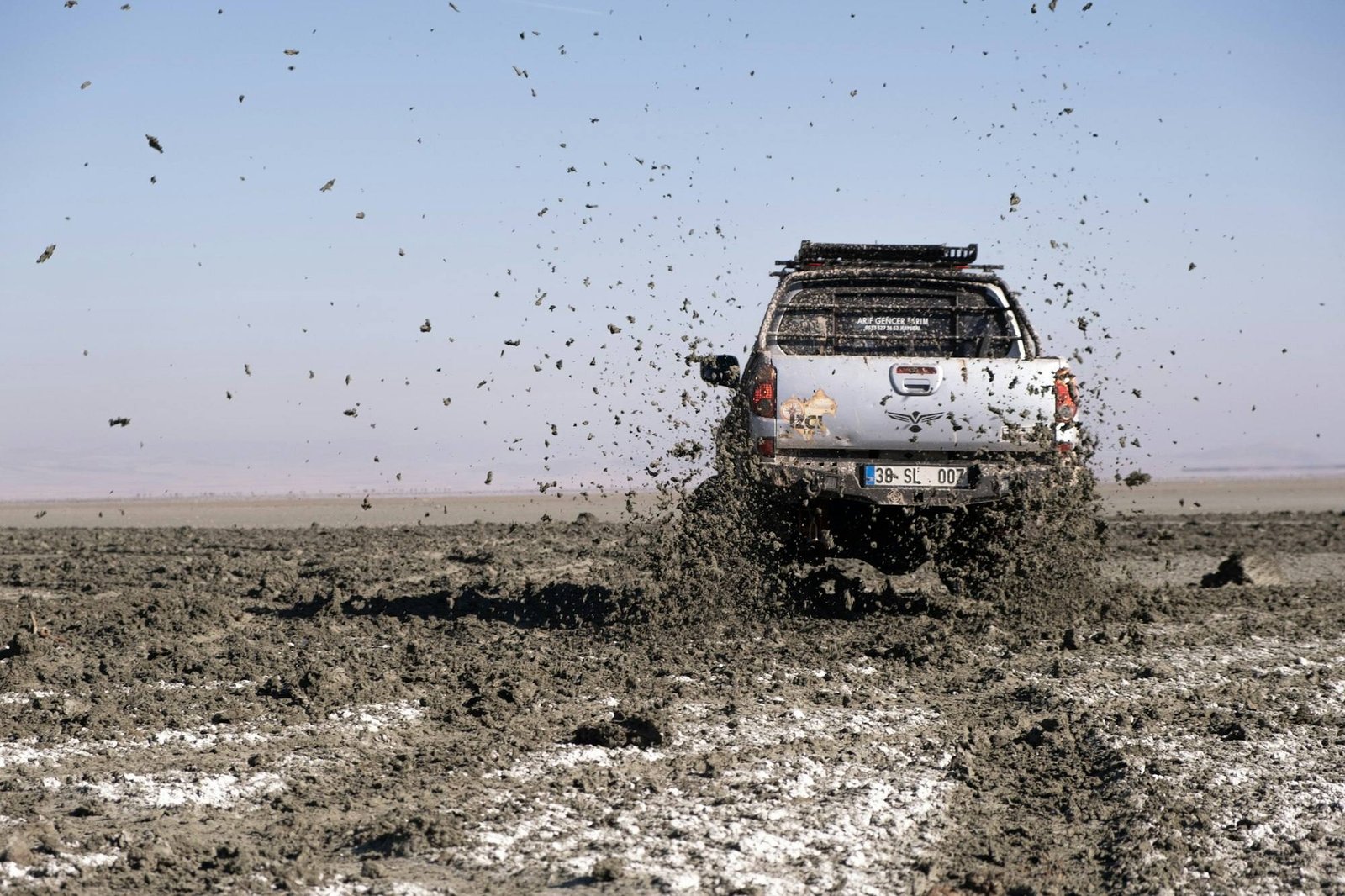
What fits, stock
Ford publishes no maximum tire size, so everything here is a supplier or owner claim. Wheel vendors say 33×12.50R20 clears on stock suspension, but on an aftermarket low-offset wheel. Owners running the factory wheel report the ceiling closer to 275/65R20 or 285/60R20. Publish the gap rather than picking one: the supplier number assumes a wheel you have not bought yet.
The FX4 package changes shocks, skid plates and the locker. It does not change ride height, track width or wheel offset, so FX4 fitment is standard F-150 fitment.
The Tremor is genuinely different: two inches taller at the front, an inch at the rear, an inch wider, and a lower-offset 18-inch wheel. Owners report 295/70R18 at 34.4 inches on stock wheels without rubbing.
What actually rubs
In the order people hit it: the lower valance and air dam first, and 2021-onward trucks have a deployable active air dam, which makes this worse than on the previous generation. Then the rubber flaps on the fender liner. Then the lower control arm at full steering lock. Then the crash bars behind the bumper.
One finding matters specifically here: two tires of the same printed size rub differently. Owners report starting to rub after switching from an all-terrain to a tire with squarer shoulders in the identical size. Every mud-terrain has squarer shoulders than the all-terrain it replaces, which means fitment charts written for all-terrains under-predict rub for mud-terrains. Test fit.
Gearing: the ten-speed changes the answer
Factory ratios are 3.15, 3.31, 3.55 and 3.73. Note that 4.10 is a Raptor-only ratio: it is not orderable on a standard F-150, and any guide listing it as a general option is wrong.
The regearing case is much weaker here than on a Jeep or a Tacoma, and the reason is the transmission. Going from 3.73 to 4.56 is a 22% change to accommodate a tire only 6% taller than stock, a wild overcorrection. The ten-speed’s ratio spread already absorbs most of what a regear would deliver, at a cost of $4,000 to $5,500 and around sixteen hours of labour.
The ratio you already have decides it, not the tire. At 3.73, don’t. At 3.55, probably don’t. At 3.31, it is worth costing out.
Recalibrating the speedometer
There is no tire-size setting in the F-150’s instrument cluster or SYNC menus. We checked the 2024 owner’s manual and it is not there.
What Ford does offer is the Ford Performance ProCal 4, part M-12655-F, at $510. Its published Tire/Gear Adjust function changes the tire size and axle ratio stored in the PCM. That is a manufacturer-supported path, which Jeep and Toyota owners do not get.
In practice most owners use FORScan to edit the tire circumference value in the body control module instead, at a fraction of the cost. That is not a Ford-supported procedure and it involves backing up a module before editing it. We mention it because it is what people actually do, not as a recommendation.
What we would buy
If your truck is on 20s and you are serious about a mud-terrain, buy 18-inch wheels first. You get more sidewall than the tire you were going to buy, a wider model selection, a better airing-down window and a lower price per tire. It is the rare upgrade that is cheaper in every direction.
On load range: Load Range C where the size offers it, unless you tow near the limit or run sharp rock. Ford built its 7,850 lb truck on a C. Your Lariat is not carrying more than that.
One retailer warning from the research. The same Maxxis RAZR MT in 35×12.50R20 was $487.91 at one retailer and $369.35 at another on the same day, a 32% spread of $474 across a set. On this platform, shopping the retailer matters more than shopping the brand.
Watch

Shock Surplus on what a half-ton actually needs to clear 35s: offset, levelling, and what gets trimmed.
Watch on YouTube →Related on Mud Tires
33-inch mud tires · tire size calculator · moving up to 35-inch mud tires · the jump to 37-inch mud tires · load range explained · towing on mud tires · the mud tire price tracker · budget mud tires · mud tires for a Toyota Tacoma · mud tires for a Jeep Wrangler JL · mud tires for a Toyota Tundra · mud tires for a Chevy Silverado 1500 · mud tires for a Ram 2500 · what mud tires cost in fuel economy · Trail Grappler vs Ridge Grappler · Nitto Trail Grappler · Tire model pages
Sources
Ford, 2025 F-150 Towing Guide (ford.com) · Ford, 2020 RV & Trailer Towing Guide, F-150 (pictures.dealer.com) · Ford, 2023 F-150 Raptor technical specifications · Ford, 2021 and 2022 F-150 specification sheets · Ford, 2024 F-150 Owner’s Manual (fordservicecontent.com) · Ford Performance, ProCal 4 tool M-12655-F and instruction sheet (performanceparts.ford.com) · Ford Authority, 2025 F-150 packages (fordauthority.com) · Tire Size, Ford F-150 tire sizes and model specification pages (tiresize.com) · Wheel-Size, Ford F-150 wheel and tire sizes (wheel-size.com) · Tire Rack, How do I check a tire’s speed rating? (tirerack.com) · SimpleTire, model pages for KM3, Trail Grappler, Open Country M/T, Wildpeak M/T01 and RAZR MT-772 (simpletire.com) · Tires-Easy, Maxxis RAZR MT 35×12.50R20 (tires-easy.com) · Rough Country and ReadyLIFT, F-150 lift kit fitment pages. Retrieved 10 September 2026.
Further reading: Ford’s own F-150 towing and payload guide · load range and ply rating tables
Cite this page: Mud Tires, “Mud Tires for a Ford F-150”, mudtires.org/mud-tires-ford-f150/ (updated ).
Source links on this site are checked every month; last check . A source on this page that had gone offline was updated to its new address on October 4, 2026. How sources are checked.