
Guide · Running costs
Do mud tires hurt fuel economy?
Yes, but most of what you’ll read puts a confident number on it that nobody has actually measured, and a good deal of the loss usually blamed on the tread is caused by something else entirely.
By Cole Harlan · Last reviewed 10 September 2026
Start with the honest part
We could not find rigorous, independently published fuel economy testing for mud-terrain tires. What exists is a large volume of retailer and blog content quoting figures with no methodology attached, and owner reports that mix several variables at once.
So this page explains the mechanisms that cost you fuel and how to separate them, rather than quoting a percentage we cannot stand behind. If you want a number for your truck, the measurement method at the foot of this page will get you a real one.
Four things take the fuel, not one
Rolling resistance. Large tread blocks deform more as they enter and leave the contact patch, and every deformation dissipates energy as heat. Deep voids reduce the contact area doing useful work while adding mass that has to be flexed.
Weight. Mud-terrains are heavier, often substantially, and it is unsprung rotating mass, the most expensive kind to accelerate and the most expensive to stop.
Aerodynamics. If the new tires are taller, they push more air and often sit further into the airflow. On a highway-biased duty cycle this can matter more than the tread pattern.
Effective gearing. This is the one people miss, and frequently the largest single factor.
The gearing trap
Fitting a taller tire raises your effective final drive ratio. The engine turns fewer times per mile, which sounds like a saving, but it also moves the engine out of the rev range the vehicle was geared for, often forcing more downshifts under load and more throttle to hold speed. On a truck that tows, the net effect is usually worse economy, not better.
It also breaks your measurement. A taller tire makes the speedometer and odometer read low: you travel further than the dash reports. Calculate MPG from those under-reported miles and the figure comes out worse than reality. A meaningful share of the fuel economy loss owners attribute to mud tires is an uncorrected odometer.
If you changed tire diameter, correct for it before drawing any conclusion. If you didn’t, gearing isn’t your variable.
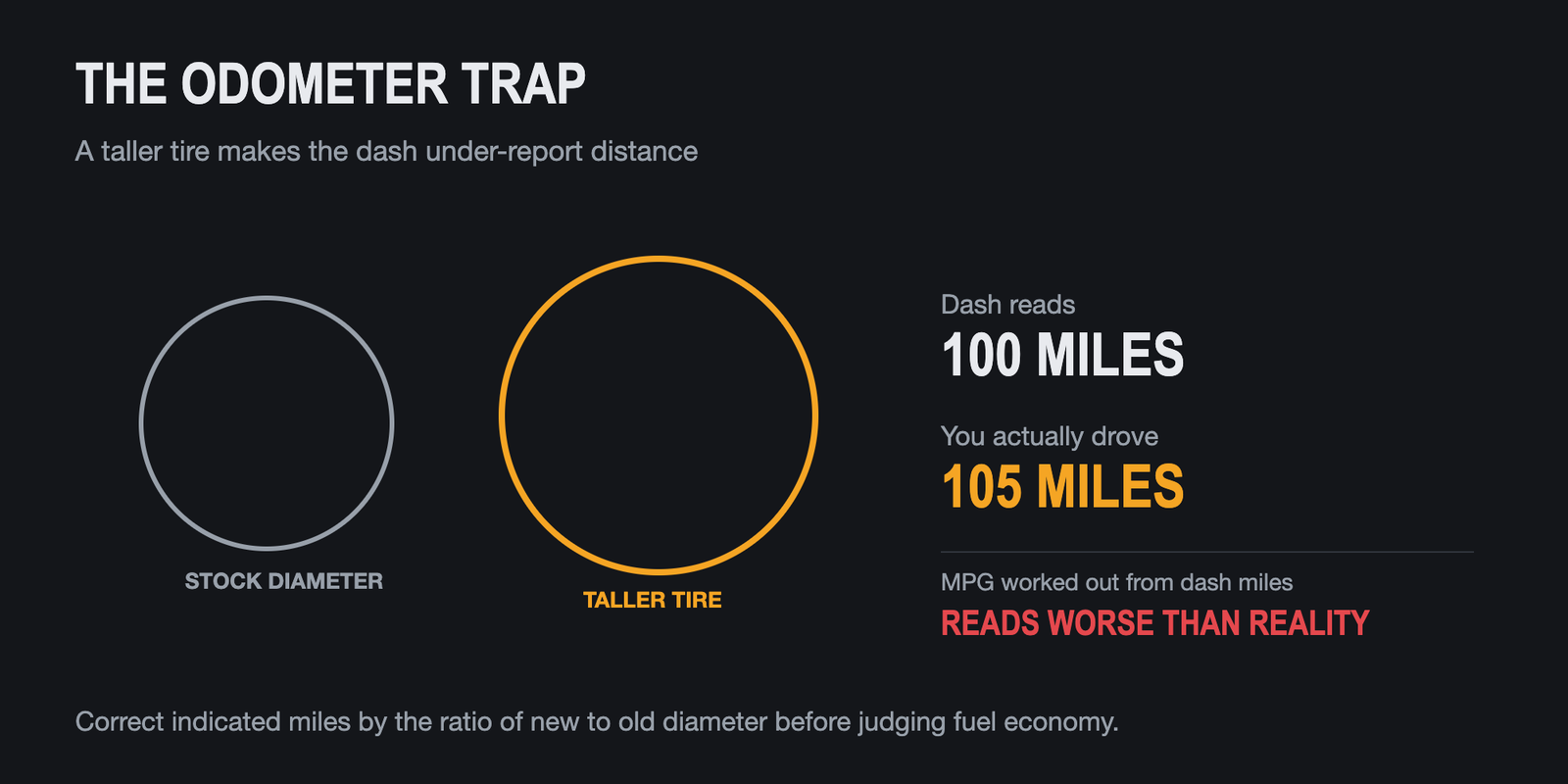
A taller tire means you travel further than the dash reports, so uncorrected MPG figures come out worse than reality.
What you control
Pressure. Underinflation raises rolling resistance directly. Set to the door placard figure for your load, and check when cold.
Load range. A heavier load range than you need adds weight and stiffness for capacity you never use. Our load range guide covers choosing correctly.
Diameter. Staying close to stock diameter avoids the gearing and aerodynamic penalties entirely, and keeps your instruments honest.
Rotation. Uneven wear increases both rolling resistance and noise. The same maintenance fixes both.
How to measure it properly
Fill to the same pump, note the odometer, drive a normal week, fill again at the same pump, and divide corrected miles by gallons. Repeat over three or four tanks before believing the result, because a single tank is dominated by traffic and weather.
Do this before the change and after it, on comparable driving. And if the tire diameter changed, multiply the indicated miles by the ratio of new to old diameter before dividing. Without that correction you are measuring your speedometer, not your tires.
Related on Mud Tires
tire size and fuel cost calculator · running mud tires as a daily driver · mud-terrain vs all-terrain · rugged-terrain vs mud-terrain · how loud mud tires actually are · moving up to 35-inch mud tires · the jump to 37-inch mud tires · airing down for mud · when to replace a mud tire · KM3 vs KO2 · Toyo Open Country M/T
Sources
No independently published fuel economy testing specific to mud-terrain tires was located during research for this page. The mechanisms described are standard vehicle dynamics; the measurement method is given so readers can generate their own figure rather than rely on an unsourced one. Retrieved 9 September 2026.
Further reading: Tire Rack on tire rolling resistance · the measured on-road penalty of mud-terrains (archived copy; the original page was removed)
Cite this page: Mud Tires, “Do Mud Tires Hurt Fuel Economy?”, mudtires.org/mud-tires-fuel-economy/ (updated ).
Source links on this site are checked every month; last check . A source on this page that had gone offline was replaced with a labelled archived copy on October 3, 2026. How sources are checked.