
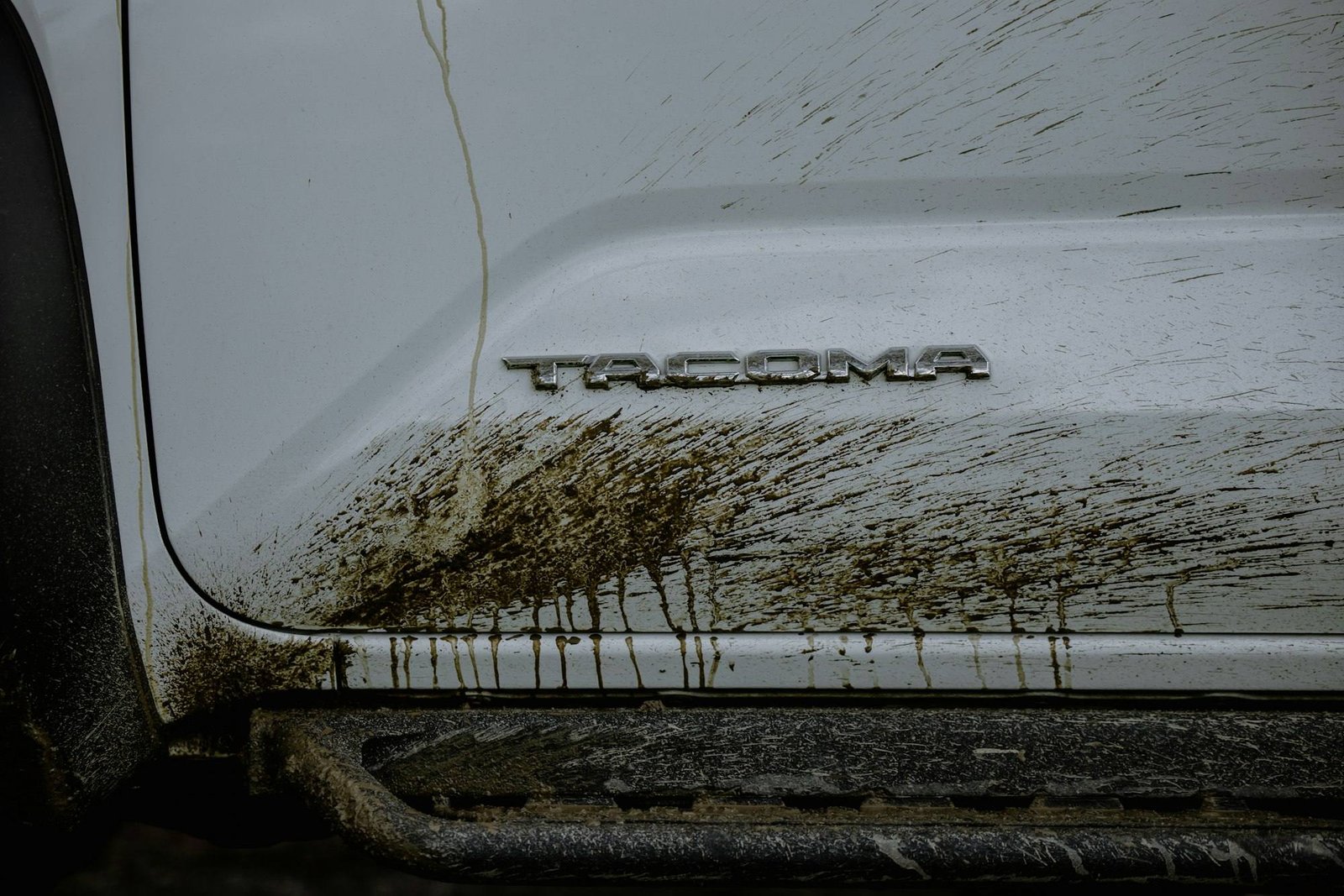
Fitment · Toyota Tacoma
Mud Tires for a Toyota Tacoma
A Tacoma has about 1,150 lb of payload and a 5,600 lb GVWR. Almost every owner fits a Load Range E tire anyway. Here is what the published numbers say about that, and what actually fits.

By Cole Harlan · Last reviewed 10 September 2026
Start with what Toyota fits
Every third-generation Tacoma, SR through TRD Pro, left the factory on P-metric tires around 30.5 inches tall. Not one trim got an LT tire.
The fourth generation is more interesting. The TRD Pro and Trailhunter, the two trims Toyota builds to be abused off-road, ship on a Goodyear Wrangler Territory R/T in 265/70R18. That tire is Load Range SL (Standard Load), weighs 39 lb, and measures 32.6 inches. Toyota’s most off-road-focused Tacoma does not use a Load Range E tire. It does not use a C either.
That single fact should reframe the whole decision, because it means an owner fitting Load Range E to a TRD Off-Road is specifying more casing than Toyota specified for the Trailhunter.

Toyota already specified 60% more tire capacity than the truck’s own GVWR permits it to use. A Load Range E set more than doubles it.
The load range question, in numbers
A 2023 TRD Off-Road Double Cab has a GVWR of 5,600 lb, and that figure is identical across every third-generation trim and configuration. Loaded to its legal maximum, that is roughly 1,400 lb per corner.
The factory P-metric tire carries 2,469 lb by load index. Because a P-metric tire fitted to a light truck has its rating divided by 1.10 under federal rules, the working figure is 2,245 lb per tire, or 8,981 lb across four. Toyota specified 60% more tire than the truck is allowed to weigh.
A Load Range E mud-terrain in LT265/70R17 carries 3,195 lb at 80 psi: 12,780 lb across four, or 2.28 times GVWR. The owner has bought roughly 3,800 lb of capacity the truck’s own GVWR forbids them from ever using. Even Load Range C, at 11,020 lb across four, is nearly double what the truck can legally weigh.
But the weight penalty is not where you think
This is where the usual version of this argument overreaches, so we will not repeat it. Within a single model and size, C versus E is nearly a wash: the Falken Wildpeak M/T in LT285/70R17 is 61.3 lb in C and 63.3 lb in E. Two pounds.
The real mass penalty comes from choosing a mud-terrain at all. The factory 33-inch Territory R/T is 39 lb. A 33×12.50R17 mud-terrain is 67.6 lb for the BFGoodrich KM3 and 70.0 lb for the Toyo Open Country M/T on tiresize’s figures, 29 to 31 lb more per corner, roughly 114 to 124 lb of unsprung rotating mass across the truck. That is the number worth arguing about, not the load range letter.
What the load range genuinely changes is casing stiffness at a given pressure. The E reaches its rating at 80 psi, the C at 50. A Tacoma needing 1,400 lb per corner runs both far below their design pressure, and the ten-ply-rated casing is simply stiffer at any pressure you choose. That is what you feel over washboard, in exchange for capacity nobody uses.
One constraint worth knowing before you decide: in LT265/70R17 and LT265/75R16, the two most common Tacoma sizes, every mainstream mud-terrain is Load Range E only. There is no C option. You only get the choice in LT285/70R17, where Nitto, Toyo and Falken all offer both, and the C is the cheaper tire.
What fits without a lift
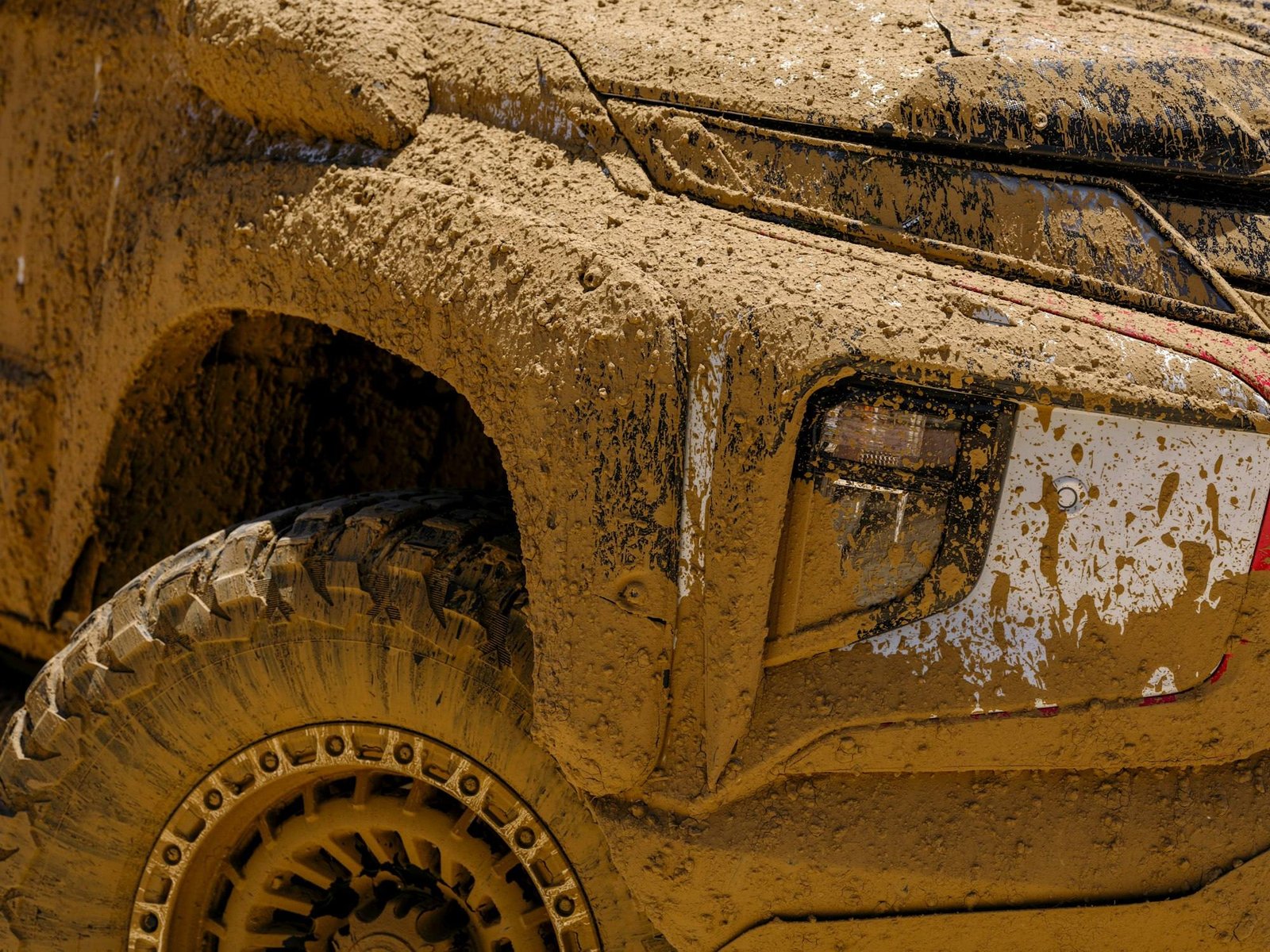
Toyota publishes no maximum tire size, so everything here is a supplier or publisher claim rather than an engineering limit. Those claims converge on roughly 31.6 to 31.7 inches on a third generation (LT265/75R16 or LT265/70R17), which is about 1.1 inches over stock.
For the fourth generation we could not find a single supplier publishing a no-lift maximum. Since the TRD Pro ships on 32.6 inches from the factory, the ceiling is plainly higher, but we are not going to invent a number for it.
What a lift actually buys
ReadyLIFT is the one supplier publishing tire sizes per kit with wheel width and offset attached, which makes its claims checkable. On a third generation, its 3-inch front kit states a 33-inch maximum, recommends 32.5 inches, and notes that 33s require “minor trimming of the inner fenderwell”. Its 6-inch kit states up to 35 inches on 9-inch wheels, minimum 18-inch wheel diameter.
On a fourth generation, its 1.5-inch leveling kit publishes 285/70R17 with no trimming, and its 3-inch kit publishes 285/75R17 clean, with 315/70R17 and 35×12.50R17 requiring minor trimming.
The cab mount chop
This is the Tacoma-specific one, and it is widely misdescribed. The body mount beneath the front firewall, just behind the wheel opening, is trimmed back and reinforced with a welded plate. It is not the fender and not the frame.
It matters because contact happens at full steering lock with the suspension compressed, which is why owners report no rubbing right up until the first tight turn on an uneven driveway. Wheel offset drives the problem as much as tire size does.
A chop is generally good for 33 inches. Thirty-fours tend to rub under full articulation because you can only cut back as far as the factory bushing, which is a hard physical limit. Thirty-fives need the mount relocated, not trimmed, a different and more expensive job.
The generation trap in wheel offset
Third-generation Tacomas run roughly +25 to +30 offset with a 106 mm hub bore. The fourth generation moved to +55 to +60 with a 95.2 mm bore.
Those wheels are not interchangeable in any useful sense, and a third-generation aftermarket spec (zero to −12 offset is common) applied to a fourth generation would push the tire out by roughly two and a half inches per side. Fitment advice written for one generation is actively dangerous applied to the other.
Gearing and the speedometer
Factory ratios: third-generation V6 automatics run 3.909, four-cylinders and V6 manuals 4.30. The fourth generation runs 3.583 across most of the range.
On regearing, we found no Toyota publication and no ring-and-pinion manufacturer publishing a Tacoma-specific tire-to-ratio recommendation. The 4.88-for-33s and 5.29-for-35s figures come from enthusiast publications attributing to their own experience. They have a plausible mechanical rationale and no engineering authority behind them, and at 33 inches the V6 automatic is only about 7% short of its factory effective ratio, so the case for regearing 33s is considerably weaker than the forums suggest.
Speedometer error from 30.6 to 31.7 inches is about 3.6%; going to LT285/70R17 is about 7.2%. The odometer errs by the same amount, which matters more: it inflates your fuel figures and under-counts miles against service intervals. We found no published Toyota recalibration procedure for the fourth generation, and owner accounts say dealers and the usual aftermarket tools cannot do it.
What is actually made in Tacoma sizes
All six major mud-terrains (BFGoodrich KM3, Nitto Trail Grappler, Toyo Open Country M/T, Falken Wildpeak M/T, Maxxis RAZR MT and Milestar Patagonia M/T-02) are offered in LT265/75R16, LT265/70R17 and LT285/70R17.
33×10.50R17, the tall-narrow size Tacoma owners often want, is not made by any of them. It exists, but only from specialist manufacturers. If you want a tall narrow tire, the real options are 255/85R16 or LT285/70R17.
What we would buy
For a daily-driven third generation staying near stock height: LT265/70R17 in whichever model is cheapest that week, accepting that Load Range E is your only option in that size, and running it at a pressure appropriate to the load rather than the sidewall maximum.
For a lifted truck where you have the choice: LT285/70R17 in Load Range C from Nitto, Toyo or Falken. It is the cheaper tire, it rides better, it still carries nearly double the truck’s GVWR, and it is closer to what Toyota specified for its own off-road flagship. Load Range E earns its place if you carry a camper, tow near the limit, or run sharp rock, and not otherwise.
Watch

Mountain Yotas walks through what 33s actually require on a Tacoma: clearance, trimming, and the lift decision.
Watch on YouTube →Related on Mud Tires
33-inch mud tires · tire size calculator · moving up to 35-inch mud tires · the jump to 37-inch mud tires · load range explained · rugged-terrain vs mud-terrain · running mud tires as a daily driver · the mud tire price tracker · budget mud tires · KM3 vs Trail Grappler · mud tires for a Jeep Wrangler JL · mud tires for a Toyota Tundra · mud tires for a Toyota 4Runner · KM3 vs KO2 · Tire model pages · Falken Wildpeak M/T
Sources
Toyota, MY23 Tacoma eBrochure · Toyota, MY24 Tacoma eBrochure · Toyo Tires, Technical Bulletin TSD-12-011, Replacing Tires on Light Trucks (toyotires.com) · Tire Rack, What is load index? (tirerack.com) · Tire Rack, Goodyear Wrangler Territory RT specifications (tirerack.com) · Tire Rack, Nitto Trail Grappler M/T LT265/70R17 (tirerack.com) · Tire Size, Toyota Tacoma tire sizes and model specification pages (tiresize.com) · Wheel-Size, Toyota Tacoma wheel and tire sizes (wheel-size.com) · ReadyLIFT, Tacoma lift kit fitment pages (readylift.com) · SoCal Prerunner, Cab mount chop (socalprerunner.com) · Road Ready Wheels, Tacoma OEM wheel listings (roadreadywheels.com). Retrieved 10 September 2026.
Further reading: Tire Rack’s off-road test run on a Tacoma · keeping overall diameter in check
Cite this page: Mud Tires, “Mud Tires for a Toyota Tacoma”, mudtires.org/mud-tires-toyota-tacoma/ (updated ).
Source links on this site are checked every month; last check . How sources are checked.