
Guide · Load
Towing on Mud Tires: What Actually Changes
Tread pattern contributes nothing to load capacity. The two numbers that matter when you hitch up are the load index and the speed rating — and mud-terrain speed ratings are lower than most owners realise.
Load index is the number that carries the trailer
Tongue weight lands almost entirely on the rear axle, and the load index is the only figure on the tire that speaks to whether the casing can carry it. Tread pattern contributes nothing.
The scale is not linear and the gaps are large: 121 is 3,197 lb, 123 is 3,417 lb, 124 is 3,527 lb, 126 is 3,748 lb. A 121 and a 126 can look identical on the shelf and differ by 551 lb per tire — over 1,100 lb across an axle.
On an LT tire you will see two numbers, like 123/120. The first applies to a single-wheel rear axle, the second when the tire is used in a dual application — where capacity is derated by 9% to account for road crown.
Never step down to a P-metric tire
When a passenger-car tire is fitted to a light truck, its load capacity is divided by 1.10 under federal rules. BFGoodrich states the practical rule bluntly: never replace original LT tires with P-metric tires, because you lose critical load capacity and durability.
The replacement standard, as Toyo and Tire Rack both put it, is that a replacement tire must have equal or greater load-carrying capacity by inflation than the original specified on the vehicle placard.
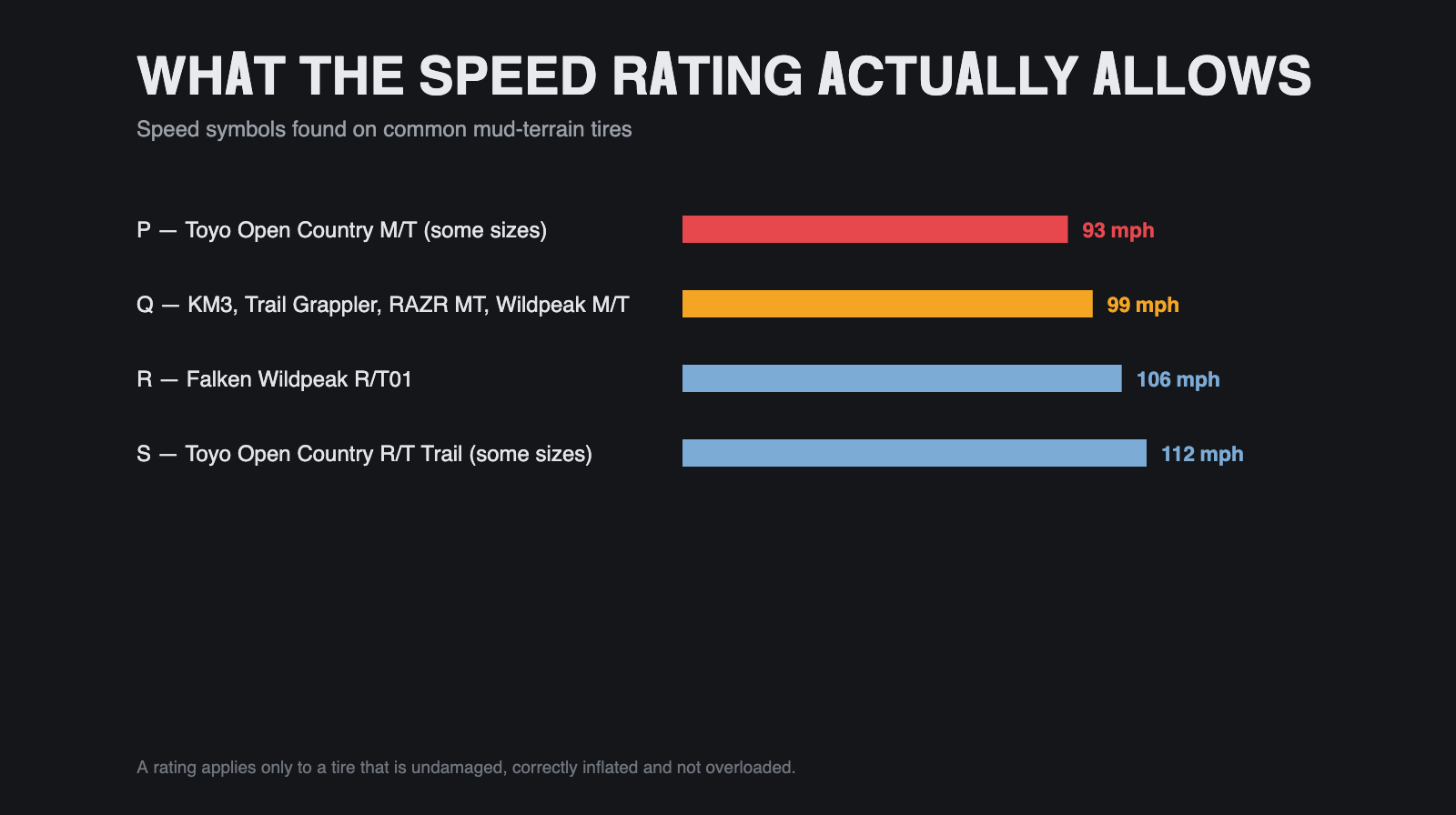
Several very common Toyo and Nitto sizes are rated P, not Q. Buyers routinely assume every mud-terrain is a Q.
The speed rating catches people out
Most mud-terrains are rated Q, which is 160 km/h or about 99 mph. But not all of them. Several very common Toyo Open Country M/T and Nitto Trail Grappler sizes are rated P — 150 km/h, about 93 mph. In LT285/70R17 the Toyo’s Load Range E is a P while its Load Range C is a Q, so choosing the heavier-duty casing actually lowers the speed rating.
What the rating means matters as much as its value. BFGoodrich defines it as the maximum speed at which the tire can carry its rated load under specified conditions — not a recommendation to drive there. USTMA is more pointed: speed ratings do not imply a vehicle can be safely driven at that speed, particularly in adverse conditions.
And Tire Rack adds the clause that matters most when towing: speed ratings only apply to tires that have not been damaged, altered, or driven under-inflated or while overloaded. A badly set-up tow rig creates exactly those conditions, and voids the rating it was relying on.
Pressure: weigh it, do not guess it
The published procedure is placard first, then the load and inflation table if the load has changed. USTMA is explicit that the sidewall number is the maximum the tire allows irrespective of the vehicle, and that you follow the placard.
Michelin’s guidance for heavy loads is the most specific we found: weigh each axle end separately, use the heaviest end to determine that axle’s cold pressure, keep pressures equal across an axle, and never exceed the maximum stamped on the wheel.
No tire manufacturer publishes an “add X psi when towing” figure, and anyone who gives you one is guessing. Weigh the loaded axle, look up the pressure that supports that load for your exact size and load range, and apply it across the axle.
Heat is the failure mode
Towing loads a tire closer to its rated capacity, which is where heat generation is highest. USTMA links under-inflation to heat build-up and internal structural damage; NHTSA links sustained high temperature to blowouts and tread separation. A mud-terrain is heavier and has more tread mass to heat than an all-terrain, and a Q-rated tire has less thermal headroom than the H-rated highway tire it replaced.
What we could not verify
Two things people will tell you confidently. First, that mud-terrain tread squirm makes trailer sway worse. The mechanism is sound — tall, widely-spaced blocks deflect laterally, so the rear axle responds later to a sway input — but we found no manufacturer, SAE paper or standards body publishing it.
Second, that mud-terrains brake substantially worse on pavement. Almost certainly true; we could not find a single head-to-head mud-terrain versus all-terrain pavement braking test with published numbers. Les Schwab will say only that highway use on mud-terrains results in less-than-ideal performance. If you want the published trade-offs, our comparison with all-terrains covers what is actually documented.
Watch
Driving Line on load range and load index specifically as they differ between all-terrain and mud-terrain tires — the core mechanism of this page.
Watch on YouTube →Sources
Tire Rack, What is load index? (tirerack.com) · Tire Rack, How do I check a tire’s speed rating? (tirerack.com) · Tires Plus, Understanding tire speed rating (tiresplus.com) · Toyo Tires, Application of load inflation tables (toyotires.com) · USTMA, Care and service of passenger and light truck tires (ustires.org) · Michelin, Proper RV tire inflation – load and inflation tables (business.michelinman.com) · BFGoodrich, Tire speed rating chart and tread life (bfgoodrichtires.com) · BFGoodrich, Off-road guide: how to choose the right tires (bfgoodrichtires.com) · NHTSA, Tires (nhtsa.gov) · Les Schwab, Mud-terrain tires (lesschwab.com). Retrieved 10 September 2026.
We may earn a commission if you buy through links on this site. Commission plays no part in which tires are listed or how they are ordered.