
Guide · On-road
How loud are mud tires, really?
Noise is the single most common regret among mud-terrain owners, and it is also the specification least likely to be published in a form you can compare.
Why the tread pattern makes noise
Tread noise comes mostly from air being compressed and released as blocks enter and leave the contact patch, plus the impact of each block striking the road. A mud-terrain has large blocks and wide voids, which means more air pumping and a bigger, more periodic impact — the exact recipe for the drone owners describe.
Manufacturers attack it by varying the block sizes and spacing around the circumference, so that the impacts don’t align into a single tone. Nitto, for instance, states it used 3D computer simulation to adjust block size, shape and position on the Trail Grappler for this reason.
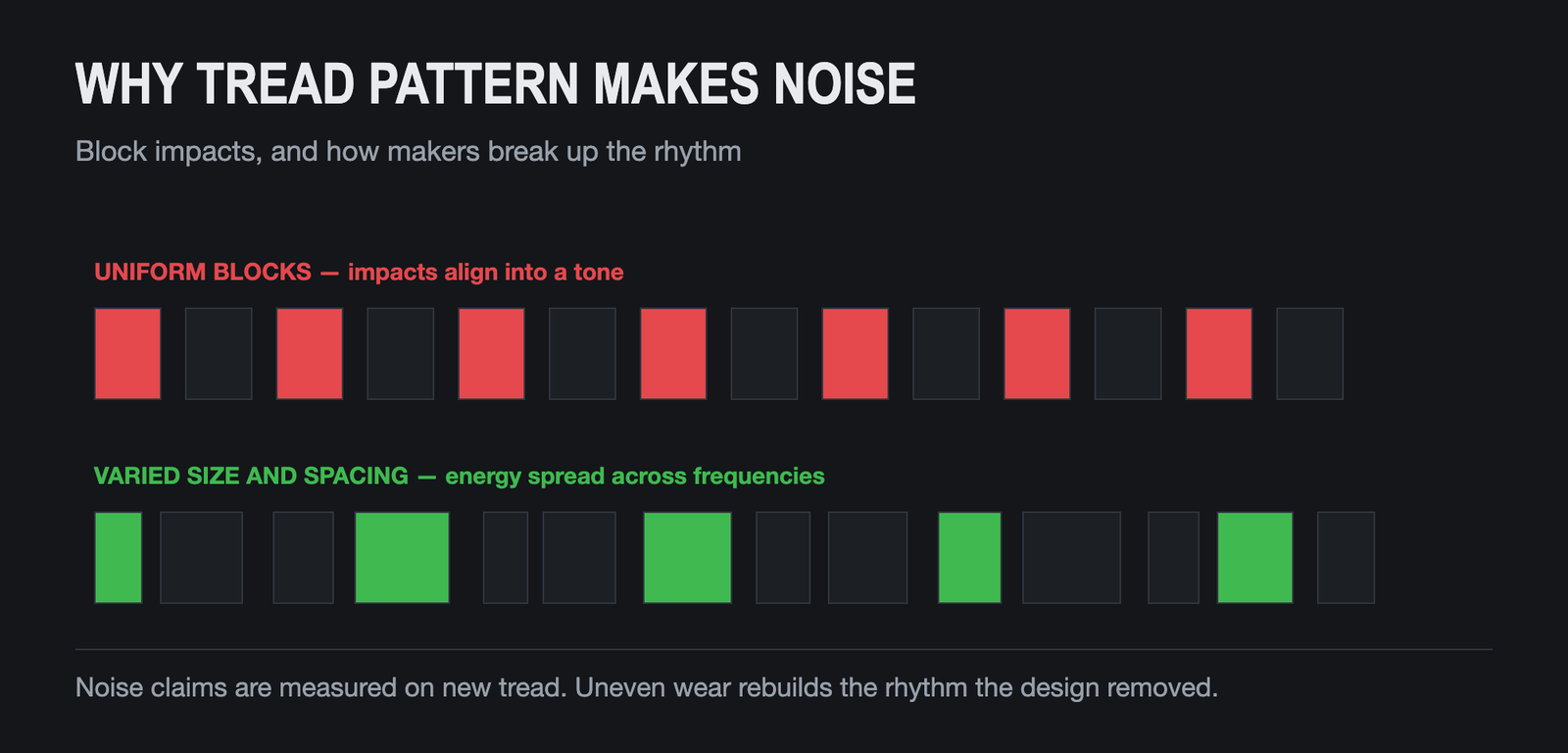
Uniform blocks produce a periodic impact — the drone owners describe. Varying block size and spacing spreads that energy.
The problem with published noise claims
In the US there is no consumer-facing noise rating printed on a tire. There is no number on the sidewall you can compare across brands, which leaves manufacturer marketing claims as the only published figures — and those are almost always relative rather than absolute.
The Trail Grappler is the clearest example. Nitto claims 34% quieter at street speeds and 36% quieter at highway speeds. Those are real figures, but they are measured against Nitto’s own Mud Grappler, a tire with a reputation as one of the loudest available. A large improvement over an unusually loud tire tells you very little about how it compares to a rival brand.
Tire
Noise information published
Comparable?
Nitto Trail Grappler M/T
34% quieter street, 36% highway, vs Nitto Mud Grappler
No — relative to a stablemate
Toyo Open Country M/T
None published
No
Falken Wildpeak M/T01
Stated to reduce road hum vs older M/T designs
No — no baseline given
BFGoodrich Mud-Terrain T/A KM3
None found in product literature
No
Not one of these figures can be placed on a common scale against another. That is the actual state of the public record.
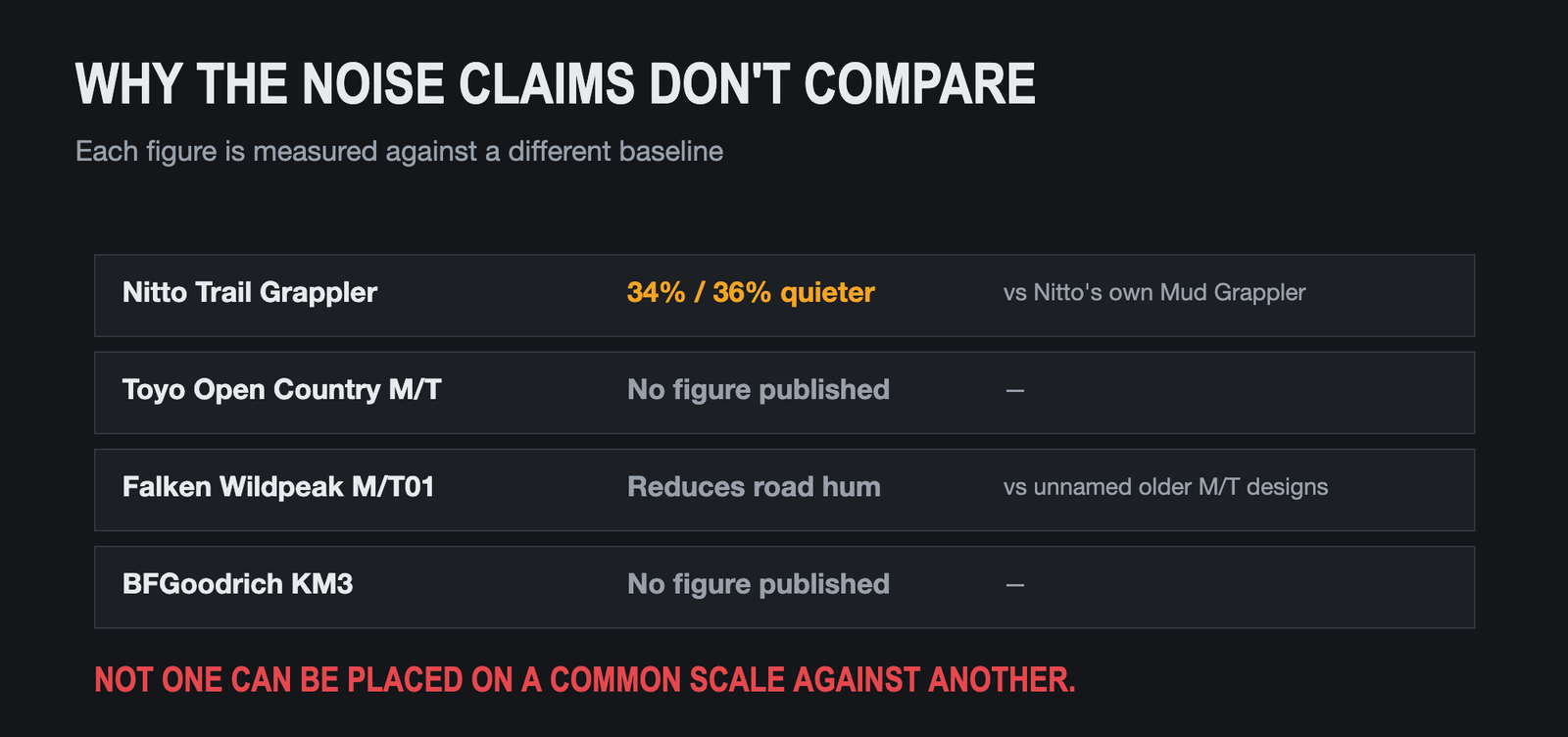
Every published noise figure uses a different baseline, so none of them can be compared with another.
It gets worse as the tire wears
Every noise claim is made on new tread. As blocks wear — and especially as they wear unevenly — the noise signature grows and often changes character, from a hum to a drone or a rhythmic slapping.
The two things that most reliably make it worse are missed rotations and running underinflated. Large tread blocks cup readily when loading is uneven, and a cupped block is a noise generator. Rotating on schedule is the cheapest noise control available to you.
What actually reduces it
Rotate on schedule, keep pressures at the door-placard figure for your load rather than the maximum on the sidewall, and choose the lowest load range that genuinely covers what you tow. An E or F rated tire on a half-ton that never tows carries stiffer construction than you need, and rides and sounds harder for it.
And be realistic about the category. A mud-terrain that is quiet for a mud-terrain is still louder than an all-terrain. If noise is your primary concern, the honest answer is a different category of tire, not a different mud-terrain.
Sources
Nitto Tire, Trail Grappler M/T product specifications (nittotire.com) · SimpleTire, Falken Wildpeak M/T01 vs Toyo Open Country M/T (simpletire.com) · BFGoodrich, Mud-Terrain T/A KM3 product page (bfgoodrichtires.com). Retrieved 9 September 2026.
We may earn a commission if you buy through links on this site. Commission plays no part in which tires are listed or how they are ordered.