
Guide · Specifications
Load range explained: C, D, E and F
Load range is the spec most often bought too high. It is not a measure of quality or toughness, and choosing more than you need costs you ride quality, fuel and noise.
What the letter actually means
Load range is a modern label for what used to be called ply rating — a measure of how much load the tire’s construction can carry at a given inflation pressure. It does not describe rubber compound, tread design, or how resistant the tire is to being cut on a rock.
The letters map to legacy ply ratings, which is why the numbering looks odd if you have never seen it before.
Load range
Legacy ply rating
Typical use
C
6-ply rating
Lighter trucks and SUVs, lower load
D
8-ply rating
Half-ton trucks, moderate loads
E
10-ply rating
Three-quarter-ton, heavier towing
F
12-ply rating
One-ton and heavy commercial loads
Ply rating is a construction equivalence, not a literal count of layers in a modern radial tire.
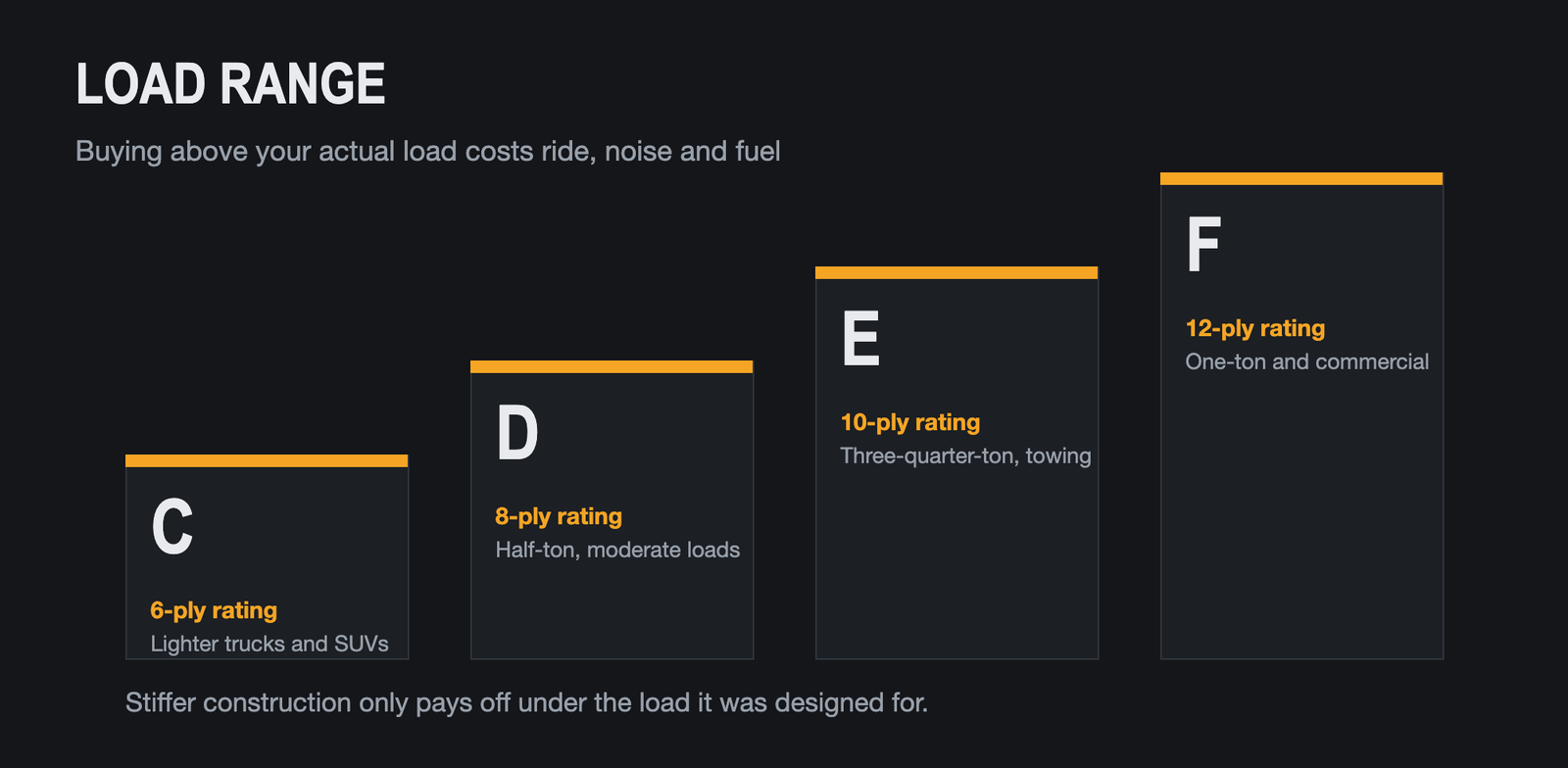
Load range is a construction equivalence, not a literal count of layers in a modern radial tire.
Why buying up hurts you
A higher load range means stiffer sidewall construction and a higher maximum inflation pressure. On a vehicle that never carries the load that construction is designed for, that stiffness has nothing to work against. The result is a harsher ride, more road noise, more weight to accelerate and stop, and a measurable fuel penalty.
This matters more on a mud-terrain than on a highway tire, because you are already accepting a noise and comfort penalty from the tread pattern. Stacking an unnecessary load range on top compounds it.
How to choose correctly
Start from the door placard on your vehicle, not from the sidewall of the tire. The placard states the load and pressure the manufacturer specified for the axle. Match the load range that covers your heaviest realistic load — fully loaded bed, trailer tongue weight included — and stop there.
The sidewall maximum pressure is the pressure at which the tire achieves its maximum rated load. It is not a recommendation, and running there on an unloaded truck reduces contact patch, wears the centre of the tread and makes the ride worse.
What load range doesn’t tell you
Puncture resistance is a separate matter entirely, governed by sidewall construction and compound rather than load rating. BFGoodrich, for example, markets CoreGard Max on the KM3 and claims 14% better sidewall puncture resistance than its predecessor — a durability claim independent of the load range you choose.
So if your concern is sidewall damage on rock, the answer is a tire designed for that, not a heavier load range of a tire that isn’t.
Availability varies by model
Not every mud-terrain offers every load range. The Nitto Trail Grappler, for instance, is published in load ranges C, D, E and F across 63 sizes from 15 to 26 inches — an unusually wide spread. Other models publish a much narrower set, and the construction can differ between sizes within a single model line.
Check the specific size you need rather than the model as a whole. Two trucks running the same named tire in different sizes are not necessarily running the same construction.
Sources
Nitto Tire, Trail Grappler M/T product specifications (nittotire.com) · BFGoodrich, Mud-Terrain T/A KM3 product page (bfgoodrichtires.com). Retrieved 9 September 2026.
We may earn a commission if you buy through links on this site. Commission plays no part in which tires are listed or how they are ordered.