
Guide · Technique
Airing Down for Mud: Pressure, Traction and Risk
Every number you have been told about off-road tire pressure came from another driver, not from a tire manufacturer. Here is what is actually published, and what the risks really are.
Nobody who makes tires will give you a number
We went looking for published off-road pressure guidance from Falken, Toyo, Nitto, Maxxis and BFGoodrich. There is none. BFGoodrich’s own 4×4 driving guide says airing down is essential in sand because it increases the footprint and helps the vehicle float — and then explicitly declines to give a figure, because it depends on the vehicle, the tires and the terrain.
That is not evasion. It is the correct answer. But it means every psi figure circulating in the off-road world is enthusiast consensus, and should be treated as such.
What the industry body does say
The US Tire Manufacturers Association publishes the only real guidance we could find, and it is two sentences: inflation pressures for most off-road use should be the same as for highway driving; if a lower pressure is used to gain flotation or traction at low speeds, the tires must be re-inflated before resuming highway or higher-speed driving.
That is a permission with two conditions attached — low speeds, and re-inflate before pavement — and no number at all.
The two published figures that do exist
Tread Lightly! suggests lowering pressure until you see a bulge, typically not below 20 psi. And Cape Cod National Seashore requires over-sand vehicles to carry a gauge that reads to 5 psi or lower, alongside a shovel, tow strap, jack and board.
Neither of those is a tire engineer’s recommendation. They are a land-use organisation and a park service setting practical floors. They are still better sourced than anything else you will be told.
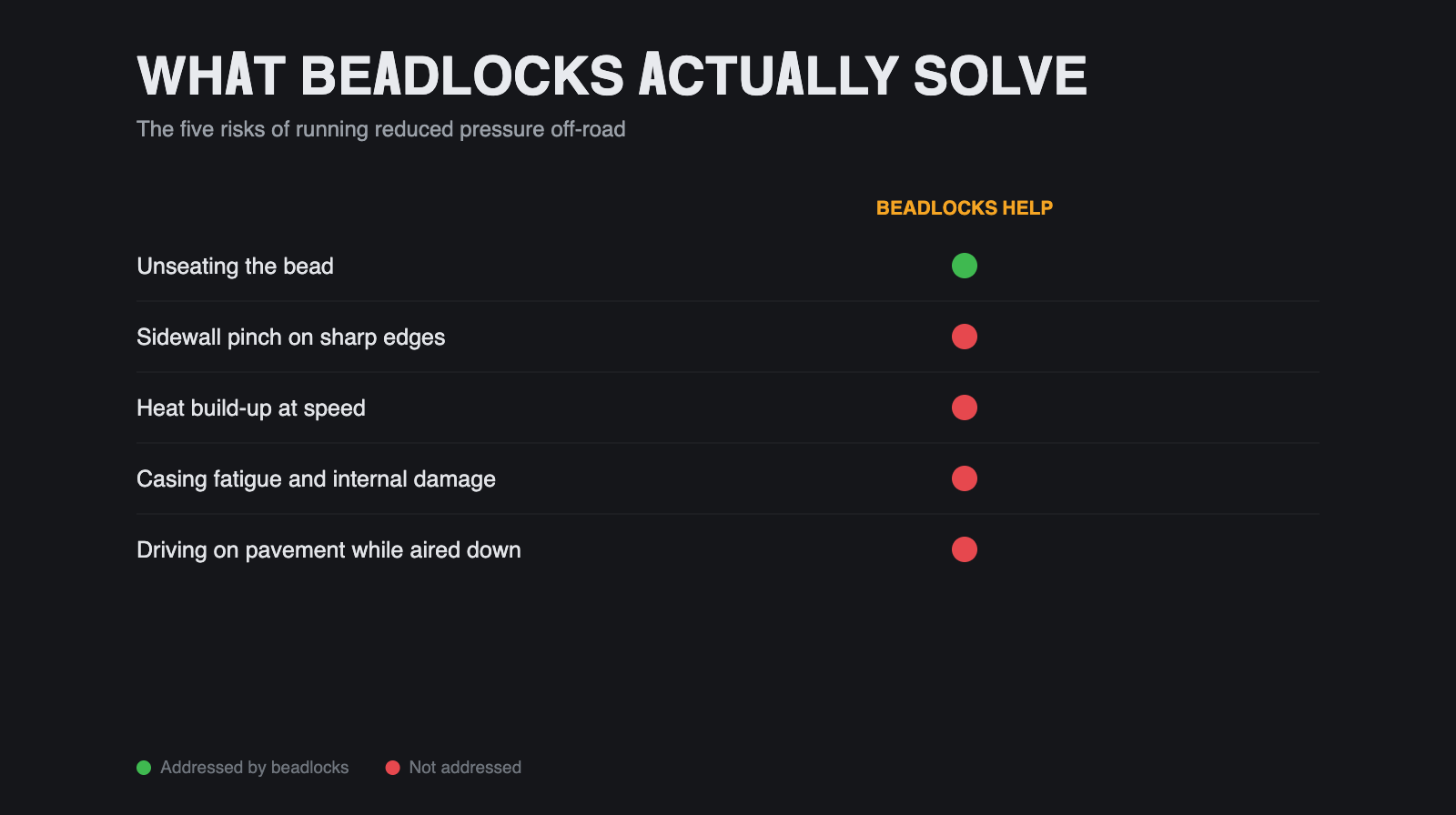
Beadlocks solve exactly one of the five risks. The other four are unchanged.
What actually happens to the contact patch
Lowering pressure lets the casing deflect, which lengthens the footprint considerably more than it widens it. The tread conforms around obstacles instead of bridging them, and ground pressure falls, which is what produces flotation on sand and soft snow. In mud, the gain is mostly conformity and the longer patch putting more lugs in contact at once.
We could not find any manufacturer or standards body publishing contact-patch area against pressure for light truck tires, so treat the mechanism as sound and the magnitude as unpublished.
Where the real risks are
Unseating the bead is the one everyone knows. BFGoodrich puts it plainly: too little pressure can unseat the tire from the rim and cause serious damage.
Heat is the one that does the quiet damage. USTMA warns that under-inflation causes excessive heat build-up and internal structural damage that may lead to failure, and NHTSA notes that sustained high temperature causes deterioration, blowouts and tread separation. Crucially, USTMA also says tires driven even a short distance while under-inflated may be damaged beyond repair. Re-inflating does not undo it.
Pinch damage — the casing being crushed between an edge and the rim — follows directly from reduced pressure over hard obstacles. No manufacturer quantifies it, but it is the most common way an aired-down sidewall dies on rock.
Your TPMS will not help you
Federal rules require the low-pressure warning to illuminate at 25% below the vehicle’s recommended cold pressure. On a truck with a 35 psi placard, that is around 26 psi. Every trail pressure you will ever run is below it, so the light will simply be on the whole time and tells you nothing.
Carry a gauge. It is the only instrument that works at these pressures.
Beadlocks, and the “DOT approved” myth
There is no such thing as a DOT-approved wheel for a light vehicle. The federal standard containing rim marking and DOT certification requirements applies to vehicles over 10,000 lb GVWR. We could find no FMVSS establishing performance requirements for aftermarket wheels on light vehicles, and NHTSA does not approve wheels — a DOT symbol on a rim is a manufacturer self-certification.
We also could not find a statute in any state prohibiting beadlocks on public roads, only forum discussion asserting it. What is real: most beadlock manufacturers label their wheels for off-highway use, the rings require periodic torque checks, and your insurer may take a view. Jeep itself sells beadlock-capable wheels and a separate Mopar beadlock ring kit, with no street-legality statement either way.
And as the chart above shows, beadlocks address the bead. They do nothing about heat, pinch damage, casing fatigue or the pavement problem.
The one rule worth memorising
Air down at the trailhead, drive slowly, air up before the pavement. Everything else is judgement. The published guidance really is that short, and the fact that no tire manufacturer will name a pressure should tell you how much confidence to place in the ones people quote at you.
Watch
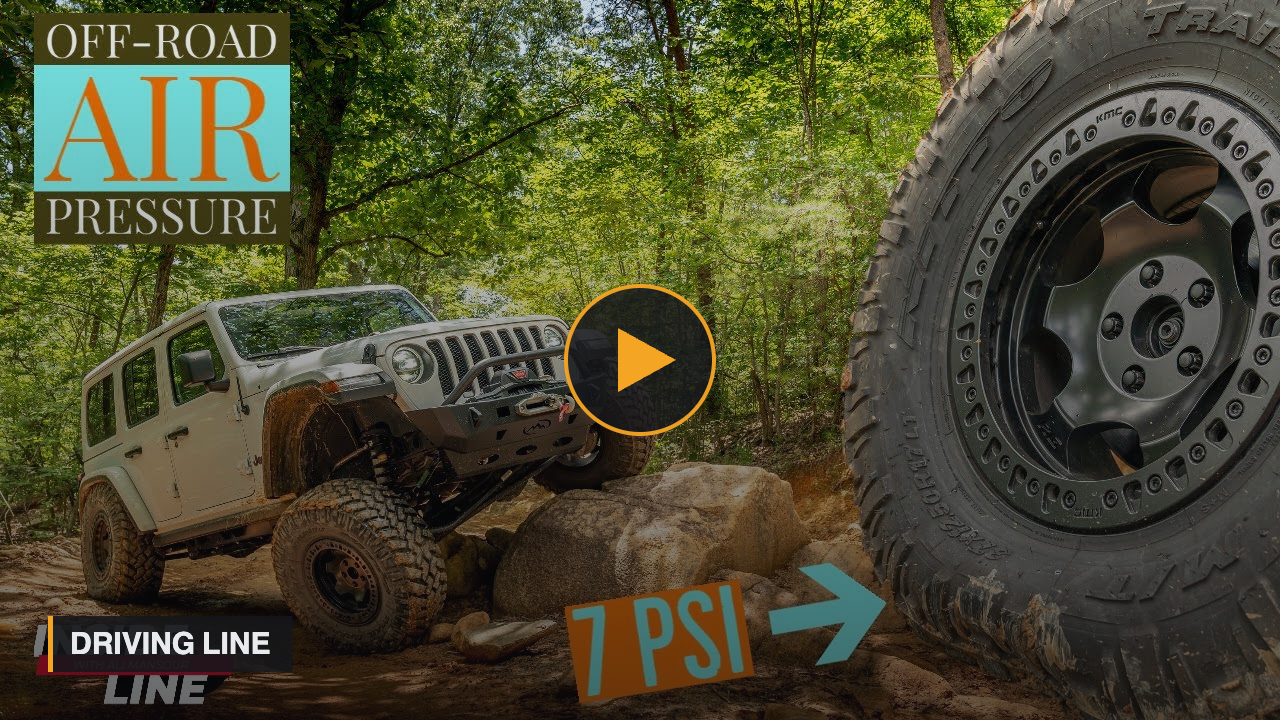
Driving Line works through pressure selection and the contact-patch versus de-bead trade-off, rather than just naming a number.
Watch on YouTube →Sources
USTMA, Care and service of passenger and light truck tires (ustires.org) · Tread Lightly!, 4×4 tips (treadlightly.org) · National Park Service, ORV equipment and tire requirements, Cape Cod National Seashore (nps.gov) · BFGoodrich, Master off-road terrain techniques (bfgoodrichtires.com) · BFGoodrich, Off-road guide: how to choose the right tires (bfgoodrichtires.com) · NHTSA, Tires (nhtsa.gov) · eCFR, 49 CFR 571.138 Standard No. 138 (ecfr.gov) · eCFR, 49 CFR 571.120 Standard No. 120 (ecfr.gov) · Jeep, Mopar beadlock wheel ring kit (gear.jeep.com). Retrieved 10 September 2026.
We may earn a commission if you buy through links on this site. Commission plays no part in which tires are listed or how they are ordered.