
Guide · Sizing
35-inch mud tires: what fits and what it really costs
The tires are the cheapest part of going to 35s. Budget for the tires alone and you will be caught out by three or four costs that arrive afterwards.
By Mud Tires Editorial Team · Last reviewed 22 October 2026
What “35-inch” actually means
A 35 is nominally 35 inches in overall diameter, usually written in flotation sizing as something like 35×12.50R17: diameter, section width, then wheel diameter. Metric sizing describes the same tire differently, as section width, aspect ratio and wheel diameter, which is why cross-shopping the two formats is confusing.
Nominal is not actual. Published diameters are measured unloaded at a specified pressure, and real mounted diameter varies between brands by enough to matter for clearance. Check the manufacturer’s published spec for the exact size, not the headline number.
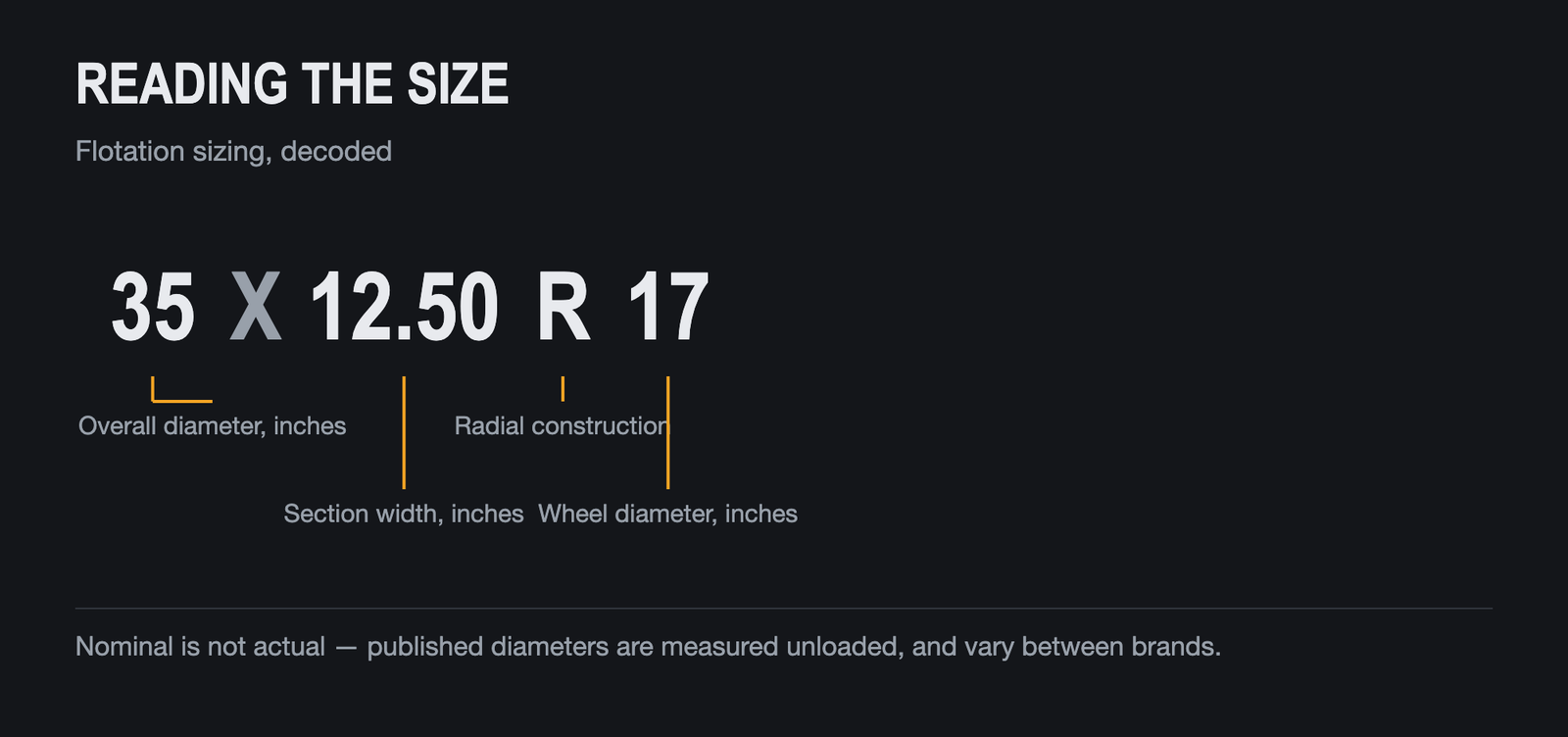
Flotation sizing states diameter, section width and wheel diameter, but nominal diameter is not actual diameter.
The costs that arrive after the tires
Cost
Why it happens
Skippable?
Lift or levelling
Clearance at full lock and full compression
Rarely; depends on vehicle and offset
Trimming
Contact at the front of the wheel arch when turning
Sometimes
Re-gearing
Taller tire raises effective final drive; performance and towing suffer
Depends on axle ratio and use
Speedometer recalibration
Taller tire makes the speedometer and odometer read low
No; it affects readings and records
Wheels or spacers
Backspacing and offset change to clear suspension
Often
Carrier or bumper changes
Spare no longer fits the factory location
Vehicle-specific
Which of these apply depends entirely on the vehicle, its suspension and wheel offset. Treat this as the list to price, not a prediction. For what lift makers state for 35s truck by truck, see do you need a lift for 35-inch tires?
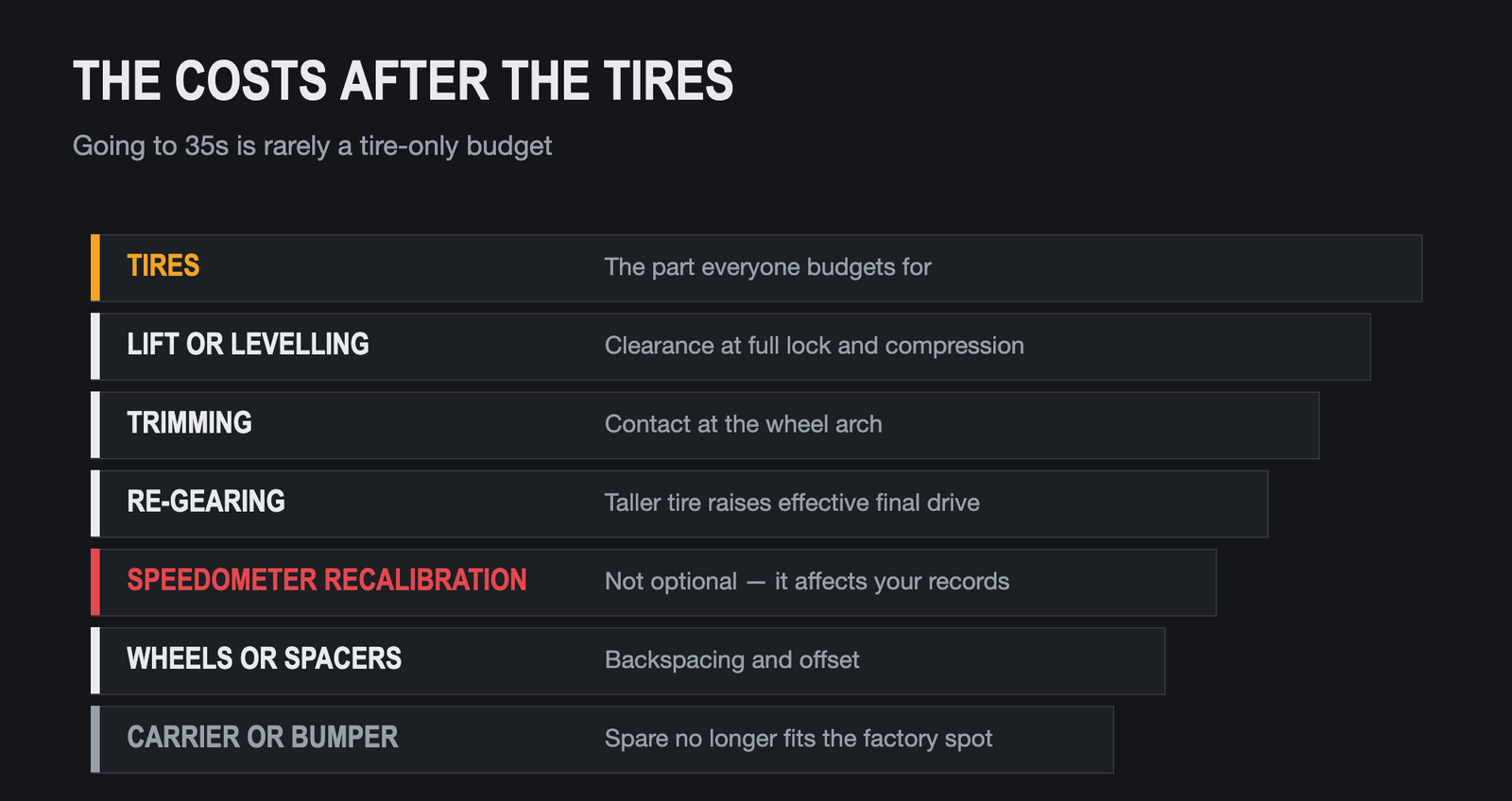
Which of these apply depends on the vehicle, its suspension and wheel offset. Treat it as the list to price.
The gearing question
Going from a stock diameter to a 35 raises your effective final drive ratio. The engine turns fewer times per mile, which sounds efficient but usually moves the powertrain out of the range it was geared for. Towing and hill performance suffer first, and the transmission tends to hunt between gears.
Whether re-gearing is worth it depends on your axle ratio and what you ask of the truck. A truck that never tows may live with it happily; a truck that tows regularly usually won’t. Our fuel economy guide explains why this also breaks your MPG measurements.
Recalibrate the speedometer, always
This one is not optional. A taller tire means you travel further per revolution than the vehicle computes, so the speedometer under-reads and the odometer accumulates fewer miles than you actually drive.
The consequences are practical: you speed without meaning to, service intervals arrive late, warranty mileage records understate use, and any fuel economy calculation you do is wrong in a direction that flatters nothing. Recalibration is cheap relative to the rest of the build.
Availability across the tires we’ve documented
Fitment breadth varies a lot by model, and this is where it becomes decisive rather than academic. The Nitto Trail Grappler publishes 63 sizes spanning 15 to 26 inch wheels in load ranges C through F, which makes it one of the more likely to have an unusual combination.
Toyo publishes 84 Open Country M/T size listings from 15 to 26 inches, also in load ranges C through F; Falken lists 28 Wildpeak M/T size and load-range combinations from 15 to 20 inches; BFGoodrich’s KM3 page says 55 sizes are available. Check the specific size before committing to a model, and note that construction can differ between sizes within one model line, so two trucks on the same named tire are not necessarily on the same tire.
Load range still matters at 35
Going bigger is not a reason to go heavier. The load range should still match what you actually carry, not the size of the tire. An F-rated 35 on a half-ton that never tows delivers a harsh ride and extra unsprung weight for capacity that never gets used.
Our load range guide covers how to pick from the door placard rather than the sidewall.
Related on Mud Tires
Sources
Nitto Tire, Trail Grappler M/T product specifications (nittotire.com) · BFGoodrich, Mud-Terrain T/A KM3 product page (bfgoodrichtires.com) · Toyo Tires, Open Country M/T (toyotires.com) · Falken Tire, Wildpeak M/T (falkentire.com). Sizing and gearing effects described are standard vehicle dynamics. Retrieved 9 September 2026; re-checked 22 October 2026.
Further reading: checking speedometer accuracy after a size change · keeping overall diameter close to stock
Cite this page: Mud Tires, “35-Inch Mud Tires: What Fits and What It Costs”, mudtires.org/35-inch-mud-tires/ (updated ).
Source links on this site are checked every month; last check . How sources are checked.